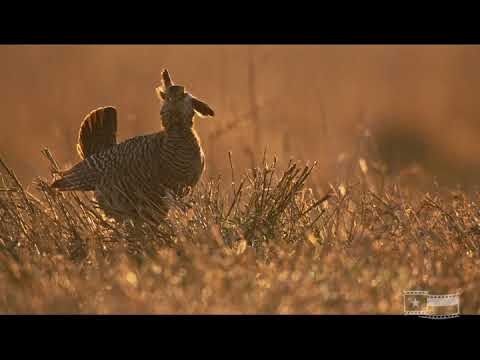
Did you know one of Texas's most iconic birds is fighting for survival right here in our own backyard?
From the shadow of legendary Texas landmarks to the wide open coastal prairies, the Lone Star State holds stories worth protecting. The 2022 short film Song of the Prairie shines a light on one of those stories — the battle to bring back the Attwater's Prairie Chicken, a rare grouse found nowhere else on Earth but the grasslands of coastal Texas.
The Nature Conservancy is leading the charge, teaming up with local ranchers and landowners in a powerful public-private partnership that's making a real difference. Kirk Feuerbacher of the Coastal Prairies Project and rancher Morgan O'Connor share how they're tackling invasive species, keeping soils healthy and productive, and restoring the biodiversity these birds desperately need to thrive.
And here's the good news — the numbers are going UP. This film wraps with a message of real hope, envisioning a wilder, richer Texas for the generations coming up behind us.
Texas has always taken care of its own. Let's make sure that includes every creature that calls this land home.
Drop a below if you'd love to see these birds make a full comeback!
Transcript
This transcript was generated automatically from the video's captions and may contain errors.
The Attwater's prairie chicken is a a native grouse species. It's a lekking species. So, every spring the males get together and they boom to attract females. They have these really large orange air sacks and an orange comb over their eye. And so they'll stomp their feet and the air sacks will fill up and the combs will fill up with air. They'll make a booming sound which you can hear it up to 3 miles away. That Attwater's prairie chicken is an iconic species of the prairie of which only about 1% of the of this acreage is left. The eerie mating call of the Attwater's prairie chicken is a haunting reminder that another wildlife species is on the verge of extinction. Where millions of Attwater's prairie chickens once lived on the Gulf Coast, now only about 1,000 remain.
They were almost at extinction and then the nature Conservancy approached my mother. She started the partnership and that has continued to this day. My name is Morgan Dunn O'Connor. This land has been in my family since 1834. From an early age, my siblings and I felt this connection to this land. Grasslands are very efficient in capturing carbon. They're very important to the watershed. capture the rainfall and allow it to soak into the soil to recharge the aquifers, but also allow that water to run off into the riparian areas and on into the bay and the Gulf at a little bit slower rate. It's a major fly zone for many, many migratory species. So, it's a really unique area that a lot of animals depend upon. This is really the last best hope for the prairie chicken as far as being large enough to have a sustainable population.
The main goal of the coastal prairies project is to maintain a contiguous grassland and help land owners to economically and ecologically be sustainable. We're able to facilitate and bridge that gap between the government and the land owners to really break ground on endangered species management and recovery. The partnership has been so beneficial to us in cost sharing and in just their general knowledge about the range conditions. It's another tool in our toolkit. We do prescribe burning on a regular basis. The Nature Conservancy helps us evaluate the conditions. You have the benefit of their scientists in their research. Treating the invasive species and rotational grazing are the two most important things you can do to conserve your land.
So, this is part of the rotational grazing system. And you see we have this narrow lane and it's just to make it easier to move the cattle from pasture to pasture. No, the rotational grazing makes all the difference. you never lose all of your good healthy grasses and that's good for the cattle and it's good for the wildlife and good for the prairie chickens also. This is where the prairie chickens are being reintroduced into the wild. And this road that we were just on um is often where you will see a dozen or more prairie chickens booming at the same time, which is about my favorite show out here. When we started this, there were a handful in the wild and now we have over a hundred and a lot of them are breeding in the wild. It's very exciting to me to be a part of the public private partnership that enables these birds to thrive again in their native habitat. And it's all part of the circle of life, you know, the animals, the land, the humans that are managing the land, hopefully managing it well and leaving it in better shape for the next generation.
No comments yet