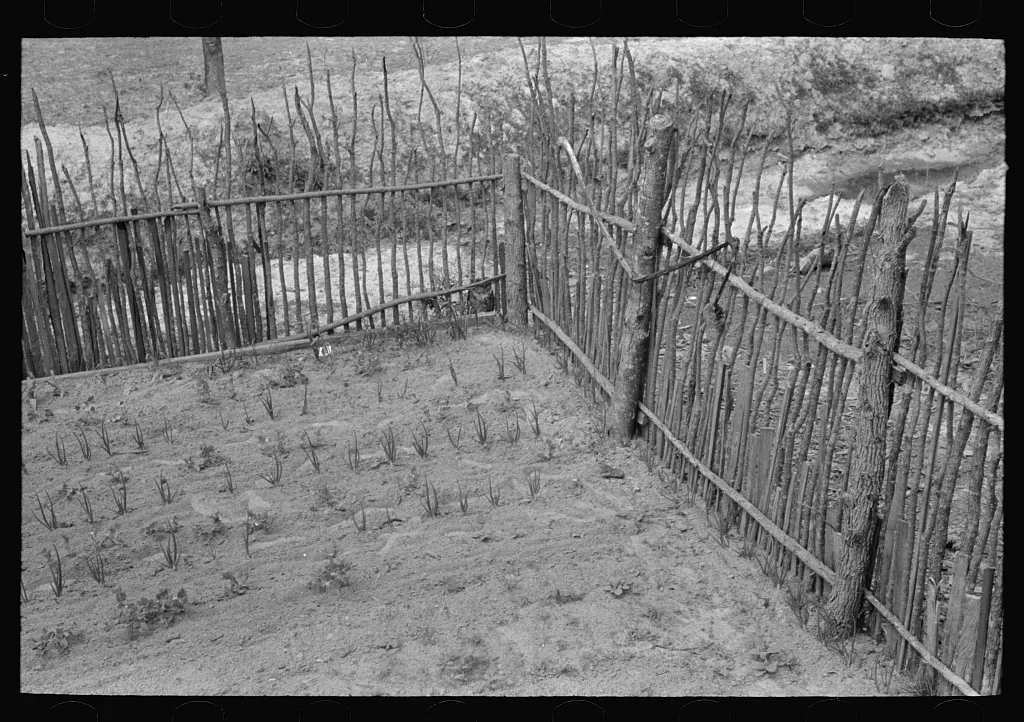
There's a fence in this photograph. That's the whole story, at first glance. A simple wire enclosure around a kitchen garden somewhere outside Jefferson, Texas — and yet that fence, captured on a 35mm nitrate negative in April of 1939, says more about Depression-era East Texas farm life than most written records do.
The image is held in the Library of Congress and carries a plain, matter-of-fact caption: Gardens in east Texas are protected from rabbits and dogs by fence. It was photographed by Russell Lee, one of the Farm Security Administration's most prolific and celebrated documentary photographers, known for his deeply respectful, unvarnished portraits of everyday Texans during the Depression. No family name survives in the caption. Just the fact of it — someone built a fence around their garden because they had to.
Jefferson, Texas in April 1939
Most people who know Jefferson know it for its Victorian architecture and its complicated history as a 19th-century river port — one of the few inland Texas cities that briefly rivaled Galveston in commercial importance, back when Big Cypress Bayou connected it to the Red River and then to New Orleans. But that era ended long before 1939. By the time this photograph was taken, Jefferson had been a relatively quiet Marion County seat for decades, its population hovering around 2,500 people.
The context matters. April 1939 sat at the tail end of a decade that had ground rural East Texas families down hard. The Great Depression had cut deep into farm income across the region throughout the 1930s. Cotton prices, which East Texas growers had long depended on, had collapsed — falling from roughly 18 cents per pound in 1929 to under 6 cents by 1931. Federal programs through the Agricultural Adjustment Act were offering some relief by the late '30s, but for small farm families near Jefferson, a kitchen garden wasn't a hobby. It was survival.
That fence wasn't decorative.
What the Garden Fence Actually Meant
April is prime planting season in the Piney Woods — the window when a family would be dropping seeds for peas, beans, squash, and tender sweet potato slips into the fresh red clay. Kitchen gardens in this part of East Texas also grew collard greens, sweet potatoes, turnips, and mustard greens for later in the year, but it's the spring seedlings that carry the real risk. The Piney Woods region — all that heavy timber and red clay soil stretching across Marion, Cass, and Harrison counties — gets enough rain that a well-tended garden could produce year-round if you knew the land. And people out here knew the land.
But rabbits and free-roaming dogs were a genuine problem. Not an inconvenient problem. A catastrophic-if-you-let-it-get-out-of-hand problem. To a cottontail rabbit, a field of newly germinated spring seedlings is a defenseless buffet — a single rabbit can cleanly slice off an entire row of tender shoots in a single night, killing the plant outright and erasing weeks of work. Dogs — many of them semi-feral or belonging to neighbors — would dig and trample as much as they'd eat. For a family that depended on that garden to supplement what little cash income came in from cotton or timber work, losing a spring planting to wildlife wasn't just frustrating. It set the table back considerably, right at the start of the growing season.
The fence in this photograph is doing serious work.
Nitrate Negatives and the FSA Project
The technical note in the LOC metadata — 1 negative : nitrate ; 35 mm — places this image within the photographic technology of its era. Nitrate film was the standard before safety film replaced it after World War II; it's notoriously flammable and chemically unstable over time, which is part of why preserving Depression-era documentary photographs has required such significant archival effort.
This image belongs squarely to the Farm Security Administration (FSA) documentary project, captured by Russell Lee during his sweeping travels across the state. The FSA sent photographers across rural America between 1935 and 1944 to document poverty, agricultural conditions, and everyday life. Lee worked alongside Dorothea Lange, Walker Evans, and Gordon Parks under that same federal umbrella. The program produced roughly 170,000 photographs, many of which ended up in the Library of Congress — including thousands from Texas. Lee shared the defining impulse of his peers: pay attention to ordinary things, because ordinary things tell the truth.
A fenced garden near Jefferson, Texas tells the truth.
What's Easy to Miss
The caption doesn't mention who lived here. It doesn't tell us whether this was a white family or a Black family — and that distinction mattered enormously in Marion County in 1939, where racial segregation shaped access to land, credit, and federal relief programs. Black farm families in East Texas were often excluded from or underserved by New Deal agricultural programs, which administered aid largely through local white-controlled committees. Their kitchen gardens carried even higher stakes.
We don't know. The photograph doesn't say, and the metadata doesn't either. That gap is worth acknowledging honestly rather than smoothing over.
What we do know is that someone — somewhere on the outskirts of Jefferson, in the deep timber country of East Texas — took the time to build a fence around something worth protecting. They had enough experience with loss to know the rabbits would come. They had enough resolve to do something about it before the greens came up.
That's what the fence says.
If you've ever driven the back roads between Jefferson and Marshall on an April morning, you know how that landscape looks — dogwoods blooming white against the pine canopy, wild mustard flanking the ditches, and damp red clay roads drying under a rising spring sun. Quiet in a specific way. And somewhere out there, in 1939, someone was tending a garden that Russell Lee thought was worth photographing.
Most people would've driven right past it.
Do you have family connections to farm life near Jefferson or Marion County? If your grandparents or great-grandparents kept a kitchen garden in East Texas during the Depression years, we'd love to hear what they grew and how they protected it.


No comments yet