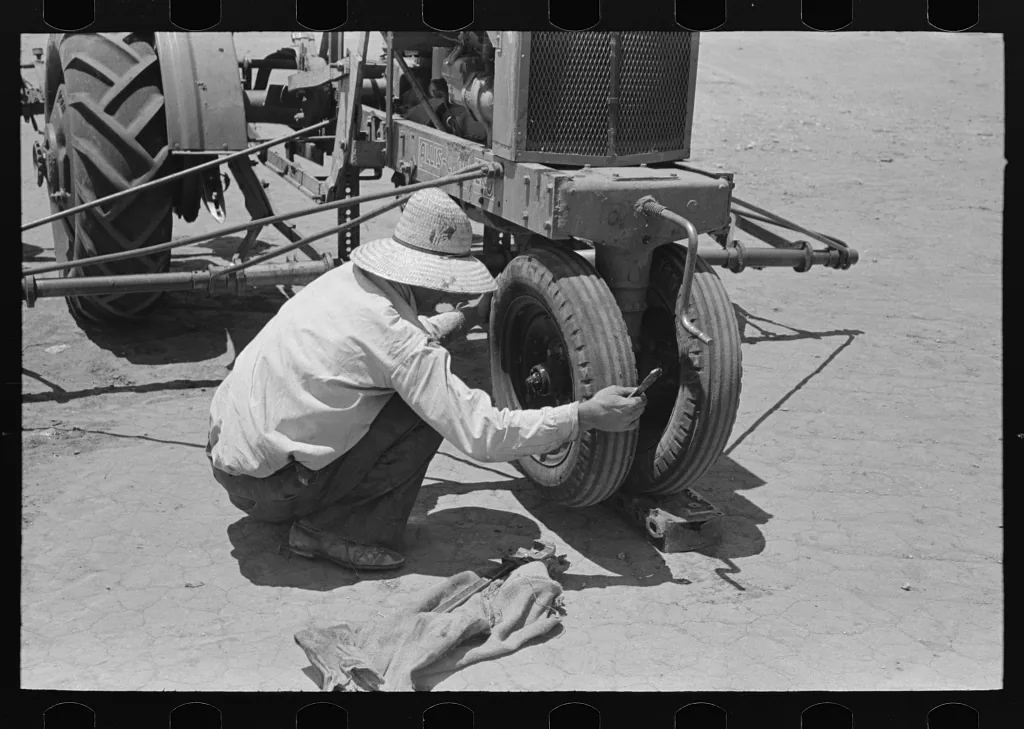
The photograph doesn't show a dramatic harvest or a proud landowner standing beside his equipment. It shows a man crouched at the wheel of a tractor, checking the play on a front wheel bearing — a small, unglamorous task that kept a 4,900-acre farming operation from grinding to a halt.
That detail matters more than it might seem at first glance.
A Day Laborer on a 4,900-Acre Operation Near Ralls
The Library of Congress holds this 35mm nitrate negative, shot in January 1939 near Ralls, Texas — a small town in Crosby County, sitting out on the South Plains about 35 miles southeast of Lubbock. The image is spare in its documentation: no photographer credit survives in the metadata, and the subject is identified only as a "day laborer." No name. No face we can put a story to.
But the context is anything but sparse.
A 4,900-acre farm in West Texas in 1939 was a serious industrial operation. That's roughly seven and a half square miles of cultivated land — almost certainly cotton, given both the region and the era. Crosby County had been cotton country since Anglo settlers broke the caprock soil in the late 19th century, and by the 1930s, mechanized farming was transforming what that labor actually looked like. Tractors had been steadily displacing mule teams throughout the decade. A front wheel bearing on a tractor wasn't just a mechanical component — it was a load-bearing piece of infrastructure for the entire season's work.
And someone had to check it.
January on the Plains
January 1939. The cotton was long since ginned. The fields were bare. This was the maintenance window — the months between harvest and spring planting when equipment got inspected, repaired, and readied for another year of hard use.
If you've ever spent time in that part of Texas in January, you know what the light looks like. Low and flat and pale, cutting across everything sideways. The wind comes off the Llano Estacado with nothing to slow it down, and the air has a particular dryness that makes your hands crack. The man in this photograph was working in that cold. Crouched down, hands probably already roughed from months of field work, pressing and rocking that wheel to feel for looseness in the bearing — a technique that's entirely tactile, learned from experience rather than a manual.
That's worth pausing on. The presence of a day laborer performing a bearing inspection challenges the notion that "unskilled" labor was inherently synonymous with low capability. Many of these men were seasoned mechanics who simply didn't own the land they worked.
The Day Laborer Economy in Depression-Era West Texas
Nobody talks about this part of the Dust Bowl and Depression narrative enough: the distinction between "tenant farmers," "sharecroppers," and "day laborers" was not just economic — it defined a person's entire relationship to the land and to security.
Day laborers were hired for specific tasks, paid by the day, and had no claim on the land, the crop, or the future. In a bad week, there was no work. In a good week, the pay was modest. The Farm Security Administration — the federal agency whose photographers documented scenes like this one across the rural South and West — was actively trying to capture these labor conditions in 1939. Their photographs were, in part, an argument for policy intervention.
According to records from the period, farm wages in Texas during the late 1930s ranged roughly from $1.00 to $2.00 per day for field labor, though day rates for mechanical work sometimes ran slightly higher. The 1940 Census of Agriculture would later show that Crosby County farms averaged well over 400 acres, meaning operations the size of this one were large-scale employers by regional standards — but that scale didn't necessarily translate into stable employment for the men doing the work.
The Ralls area drew both local labor and migratory workers following the agricultural calendar across the Southern Plains. Whether the man in this photograph was a local resident or someone who'd followed work to Crosby County is something the image simply can't tell us.
The Tractor Itself
The photograph's caption identifies the task precisely: testing the "play" on a front wheel bearing. In mechanical terms, "play" refers to the amount of lateral or rotational looseness in a bearing assembly — too much, and the wheel wobbles under load, accelerating wear and risking failure in the field. It's a pre-inspection check that a good mechanic does by hand before committing to a deeper teardown.
The tractor visible in the photograph — its make indeterminate from the metadata alone — would have been among the machines reshaping West Texas agriculture in the 1930s. John Deere, International Harvester's Farmall division, and Oliver were all competing aggressively for the Plains farm market during this decade. The shift from horse and mule power to internal combustion was rapid: between 1930 and 1940, tractor numbers on Texas farms roughly doubled, according to USDA agricultural census data.
That shift had a human cost. More tractors meant fewer hands needed per acre. Day laborers were competing in a labor market that was being mechanized out from under them — and yet here was one of those same laborers, keeping the machine running.
What the Nitrate Frame Holds
This photograph survived as a nitrate negative — a format that was standard for 35mm film through the mid-20th century but notoriously unstable over time, prone to deterioration and highly flammable. The fact that it's now in the Library of Congress collection means it was preserved deliberately, held as part of a larger effort to document American rural life during one of the hardest decades in the country's history.
Most people who look at Depression-era farm photographs see the hardship. And it's there. But what I keep coming back to in this image is the competence. A man who knows what he's doing, doing it carefully, in January, on someone else's 4,900 acres.
He didn't own the land. He probably didn't own the tractor. But the work was real, and so was the knowledge behind it.
Do you have family connections to the farming communities of Crosby County or the Ralls area during the Depression and Dust Bowl years? We'd love to hear what your family remembers about day labor, mechanization, and what it took to keep those big operations running through the 1930s.



No comments yet