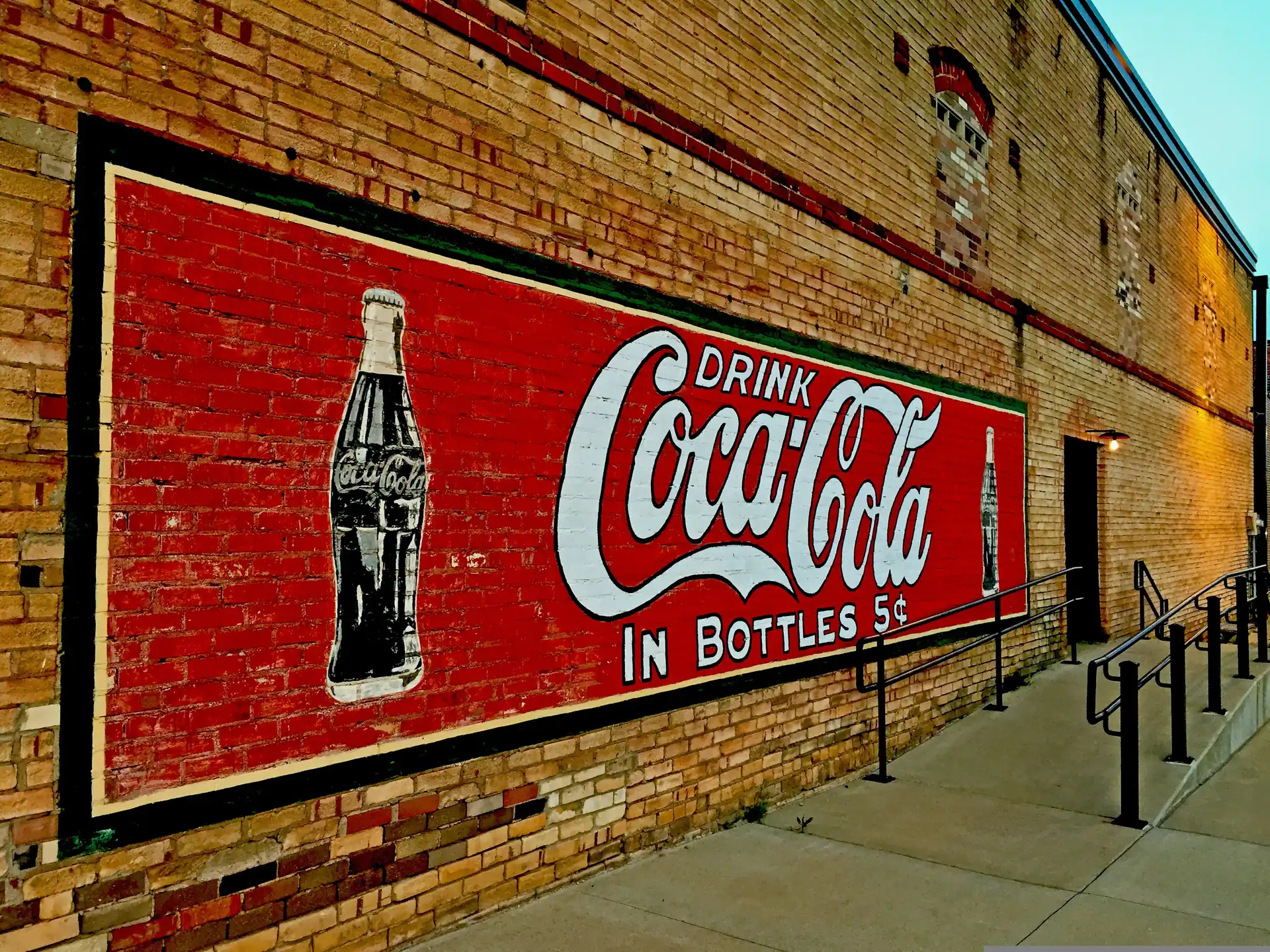
Walk the right block of historic downtown Kilgore and you'll stop mid-stride. Not for a marker, not for one of the steel derrick replicas capped with stars — but for a wall. Red and white, hand-lettered, unmistakably Coca-Cola. It's the kind of thing you almost don't see anymore, which is exactly why you do.
The Coca-Cola mural in Kilgore is a nostalgic tribute to vintage advertising, blending timeless charm with the historic downtown atmosphere. But that tidy description barely scratches the surface of what this thing actually is. It's a surviving artifact from the golden age of painted wall advertising — and it's sitting in a town that the twentieth century hit harder, and faster, than almost anywhere else in Texas.
Kilgore Before the Derricks
The town itself predates the oil by about sixty years. Planters from the Old South first settled the area before the Civil War, but the town itself wasn't born until 1872. That year, the International-Great Northern Railroad laid tracks between Longview and Palestine. Bypassing New Danville, the railroad platted a new town on 174 acres purchased from Constantine Buckley Kilgore, naming the stop in his honor.
A quiet place, mostly cotton. By 1885, Kilgore had two steam gristmill-cotton gins, a church, and a district school; the estimated population was 250. By 1914, the town had climbed to around 700. Then came October 1930 — and everything changed in a matter of days.
The discovery of the surrounding East Texas oilfield in the fall of 1930 transformed Kilgore from a declining rural community into a boomtown. Within days, thousands streamed into town, erecting tents and shacks in every available vacant space. Numerous wells were drilled in the city itself, and at the height of the boom there were over 1,100 producing wells within the city limits. On part of one downtown block in the early 1930s stood the greatest concentration of oil derricks in the world — the area came to be known as the "World's Richest Acre."
By 1936 the town's population had swelled to 12,000. To deal with the onslaught, the city incorporated in February 1931. Think about what that means in practice: a town of 700 souls suddenly hosts more than 12,000 people, most of them arriving with nothing but the clothes they're wearing and the news that there's oil money to be made in East Texas.
Those people needed places to sleep, eat, drink. They needed commerce. And commerce, in 1930s America, needed walls.
The Art of the Wall Dog
Between the 1880s and 1950s, advertisements were commonly painted on the sides and corners of downtown commercial buildings throughout the country. These "ghost signs" were commissioned by private companies and hand painted by groups of sign painters known as "wall dogs" — tradesmen who represented a variety of skills, including draftsmen, chemists, artists, and even acrobats.
The name fits. They were called walldogs for two reasons: first because they worked like dogs — you try painting a 30-foot brick wall in the blazing heat — and because sliding up and down the side of a building meant they needed to be tethered, leashed to the wall.
Coca-Cola was maybe the greatest patron these painters ever had. The very first Coca-Cola wall mural is believed to have been painted on the side of a drug store in Cartersville, Georgia, in 1894. Back then, Coca-Cola was brand new and unknown, and shortly after marketing genius Asa Candler bought the little-known beverage in 1891, he commissioned sign painters to fan out across the country to extol the virtues of the fledgling drink.
The scale of what followed is hard to fully take in. By 1910, a quarter of the Coca-Cola Company's advertising budget was dedicated to wall murals — as many as 16,000 wall murals were painted by the company and its many local bottlers. You couldn't build a town in America without Coke eventually showing up on a wall.
The Sign Finds the Town
Here's where Kilgore and the mural's story converge. The boom hits in 1930. Thousands arrive. Buildings go up fast — commercial buildings, brick where the money allowed, frame where it didn't. Boomtown diversions like movie theaters and baseball clubs offset the chaos, and oil revenues helped build Kilgore College. Every new business on every new block was a potential canvas.
A Coca-Cola mural in downtown Kilgore wasn't an accident of geography. It was the system working exactly as designed — a local bottler, a traveling walldog, a building owner willing to rent out his blank wall for a few dollars. The result was an ad that would outlast the boom itself.
The huge increase in production caused oil prices to fall precipitously, and in August 1931, Governor Ross Sterling ordered martial law to control production. The boom began to subside in the mid-1930s, and by the eve of World War II it was largely over, although oil production in the area continues.
The derricks came down. The tent towns cleared. But the red-and-white letters on the downtown wall stayed exactly where the walldog had put them.
A Ghost Sign with a Pulse
Murals waned in popularity in the 1970s, but in recent years artists have restored and repainted vintage Coca-Cola murals, giving these "ghost signs" a second life. The Kilgore mural has survived that full arc — the boom years, the quiet decades that followed, the slow revival of downtown Kilgore as a cultural district.
Today it's one of the stops that Visit Kilgore lists alongside the World's Richest Acre and the Texan Theater as a genuine downtown photo attraction. That's not nothing. In a town where the TSHA Handbook of Texas marks history at every other corner, the mural has earned its place.
If a ghost sign is not maintained or restored it will disappear over time — but restoration is a topic that causes much debate. Repainting a historic sign can destroy the patina associated with its authenticity. However, the case has been made that repainting ghost signs can support downtown revitalization efforts, supporting heritage tourism and reinforcing a unique sense of place rooted in the community's history.
That tension is real. Nobody can tell you whether the Kilgore mural is original, restored, or some combination of both — and that ambiguity is itself a piece of the story. Unlike murals and paintings, it's rare for signs to have an artist's signature. The walldog who painted it didn't leave his name. He moved on to the next town. The sign was never about him anyway.
What It's Really About
Most people photograph it and keep walking. That's fine — the image alone is worth the stop. But spend a minute with the context and it gets more interesting.
When that mural went up, Kilgore was one of the most chaotic places in Texas. Drilling increased rapidly from seven wells every two weeks to seven wells a day and then to one hundred a day and more. The first oil produced sold for $1.10 a barrel, but the price dropped to 15 cents as supply flooded the market. In the middle of all that scramble — the roughnecks, the lease hounds, the speculators — somebody climbed a ladder, dipped a brush in red lead paint, and lettered out the most recognizable advertisement in American history.
It's still there. The boom isn't.
The Kilgore College Rangerettes, the world's first precision dance drill team, were founded in Kilgore in 1940 by Gussie Nell Davis — another thing this town invented that outlasted the chaos that made it. There's a pattern there, if you're paying attention.
Have you stopped at the Coca-Cola mural on your way through Kilgore? What other ghost signs have you spotted in East Texas — and do you think they're better left as true ghosts or given a fresh coat? Tell us in the comments.

No comments yet