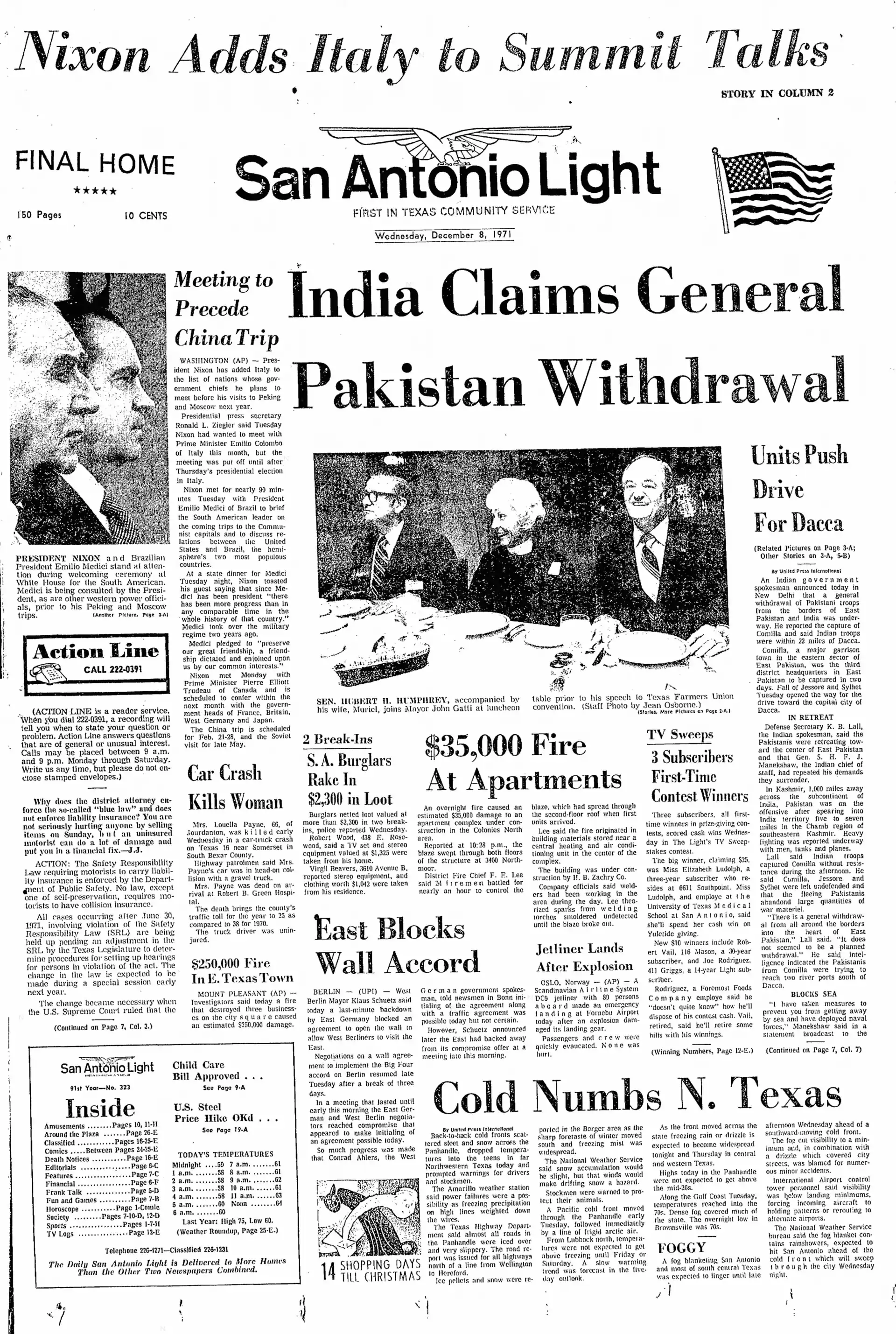
The front page of a newspaper is a kind of time capsule. Not just for the headlines — but for the typography, the column widths, the advertisements wedged between crises, the whole visual grammar of how a city understood itself on a particular morning. This front page of the San Antonio Light, dated December 8, 1971, is exactly that kind of artifact.
And the Light itself deserves more than a footnote.
A Paper That Ran for Over a Century
The San Antonio Light published continuously from 1881 until 1993 — 112 years of daily journalism in one of Texas's most complex, layered cities. That's the kind of longevity that outlasts entire generations of readers and editors, anchoring a running daily record of the very city that shaped it.
William Randolph Hearst's media empire acquired the paper in 1924, and it operated under the Hearst Corporation banner for most of the 20th century. For decades, the Light competed directly with the San Antonio Express-News — both papers fighting for the same readers in a city that was growing fast, changing faster, and sitting at a crossroads of Anglo, Mexican American, and military cultures that didn't always move in the same direction at the same speed.
San Antonio in 1971 was a city of roughly 650,000 people. Fort Sam Houston, Randolph Air Force Base, Lackland, Kelly, Brooks — the military was woven into the city's economy and identity in a way few American cities could match. Whatever was happening in Vietnam, in Washington, in the broader turbulence of the early 1970s, it landed differently in San Antonio than it did almost anywhere else.
December 8, 1971 — The World That Morning
The date matters. December 8, 1971 — one day after the 30th anniversary of Pearl Harbor, and the United States was still deeply entangled in Southeast Asia. The Indo-Pakistani War was in its second day, having erupted on December 3rd; India would declare a ceasefire and Pakistan would surrender on December 16th. Nixon's wage and price controls, imposed in August of that year, were still reshaping the domestic economy.
What Made the Light Different
The Light positioned itself as the scrappier, more working-class alternative to the Express-News. Its sports coverage — particularly of high school football, which in San Antonio functioned less as entertainment and more as civic religion — was considered essential reading. If you wanted to know what happened Friday night at Alamo Stadium, you read the Light.
The End of an Era
In 1993, the Hearst Corporation made a decision that stunned the city: they would close the Light rather than continue losing ground to the Express-News. The final commemorative edition ran on January 28, 1993. Hearst then purchased the Express-News outright, consolidating San Antonio's newspaper market into a single daily.
Some of the Light's staff transferred over. The archives — photographs, morgue files, decades of documented San Antonio life — were donated to the University of Texas at San Antonio, where researchers can still access them today.
Why a Front Page from 1971 Still Matters
A single front page doesn't tell the whole story of a newspaper, or a city, or a year. But it's evidence — physical, datable, specific — that on December 8, 1971, editors in San Antonio made choices about what their readers needed to know. Because that page is now in the public domain and fully digitized, it stands as a freely accessible primary source — an unfiltered window into a single South Texas morning.
If you grew up reading the San Antonio Light — or if someone in your family did — what stories do you remember it covering that felt like they captured the city exactly right? The deep cuts matter here: not the big national headlines, but the local stories that the Light told and the Express-News might have missed.

No comments yet