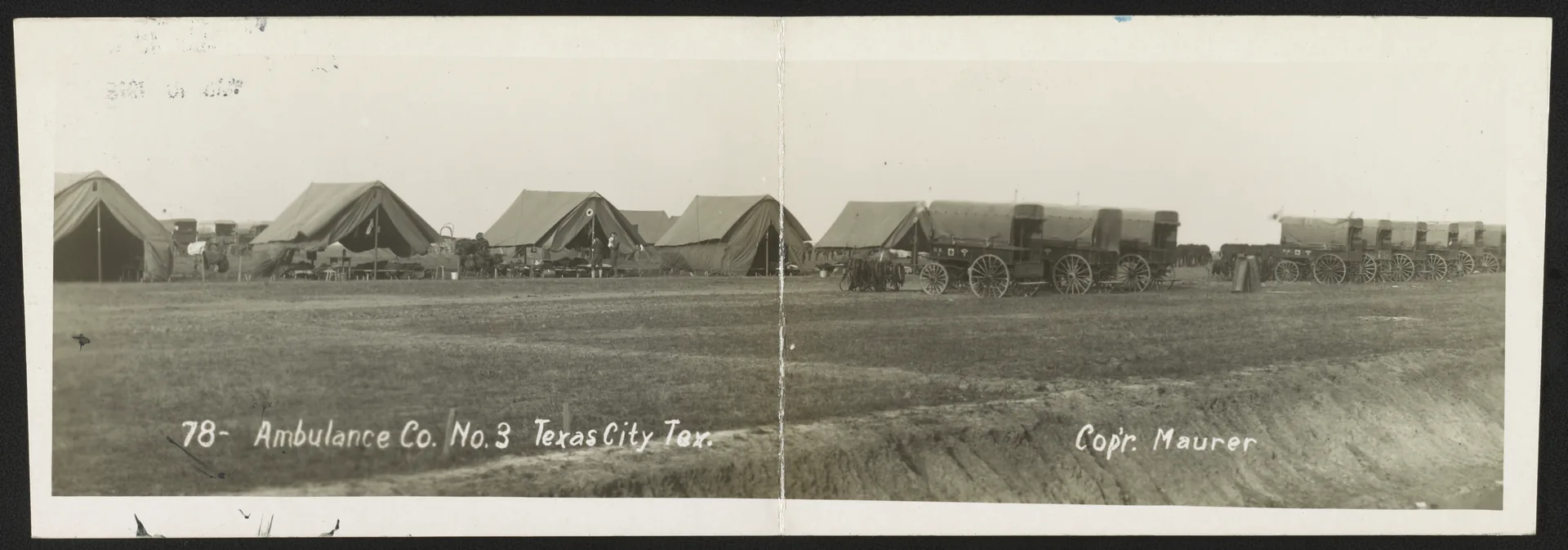
There's a photograph — a panoramic postcard, actually — taken sometime around 1913 in Texas City, Texas. Photographer Joseph M. Maurer framed it carefully: a group of men, their wagon or vehicle, the flat coastal horizon that defines this part of Galveston County. It's catalogued today in the Library of Congress under the Miscellaneous Items in High Demand collection, which tells you something right there. People keep looking for this one.
The subject is Ambulance Company No. 3.
That detail is easy to scroll past. But stop for a second and let it land — because it's not what it looks like. This wasn't a municipal service Texas City had organized on its own. Ambulance Company No. 3 belonged to the United States Army's 2nd Division, and its presence on the Texas City waterfront was the result of one of the largest peacetime troop mobilizations the country had seen to that point.
A Tiny Port Town Suddenly Hosting Half the U.S. Army
Texas City was essentially constructed from scratch beginning in the 1890s, engineered as a deep-water port on Galveston Bay to compete with — and ultimately complement — its more famous island neighbor. The Texas City Improvement Company platted the townsite in 1893, and within a few years, a causeway, a rail line, and a man-made turning basin were pulling freight and passengers through what had previously been marshland and prairie.
By the early 1910s, the town was still tiny — fewer than two thousand civilians, with the population reaching just 2,509 by the 1920 census. Grain elevators, cotton compresses, a municipal pier stretching into the bay — the infrastructure ambitions were real, but the town itself was still finding its footing.
Then, in February 1913, everything changed. Political instability from the Mexican Revolution had President William Howard Taft worried about the border, and the War Department ordered a sudden, massive mobilization: nearly the entire 2nd Division of the United States Army, roughly 14,000 soldiers, poured into the open fields just north of the Texas City limits. Two local businessmen, A. B. Wolvin and Hugh B. Moore, had lobbied hard for exactly this — a permanent Army presence anchoring the town's future. What they got, almost overnight, was a military population nearly seven times the size of the civilian one.
What Ambulance Company No. 3 Actually Was
Joseph Maurer wasn't documenting a hometown fire department. He was working, in effect, as the unofficial camp photographer for the 2nd Division — and his panoramic prints were later compiled into a souvenir booklet titled Camp of Fourth and Sixth Brigades, Second Division, United States Troops at Texas City, Texas, 1913.
That booklet lists the units stationed at the camp in detail: the Fourth and Sixth Infantry Brigades, the Fourth Field Artillery, the Sixth Cavalry, Engineer Companies G, H, and M, Field Hospital No. 3, Field Bakery No. 2 with its twelve ovens, the Aviation Squadron — the 1st Aero Squadron, America's first operational military aviation unit — and Ambulance Company No. 3. The numbered system wasn't a young city's improvised civic pride project. It was the standard organizational structure of a U.S. Army division's sanitary train, dropped wholesale onto a stretch of Gulf Coast prairie.
The men in Maurer's frame aren't local shopkeepers volunteering after hours or municipal employees on a city payroll. They are U.S. Army regulars, dressed in wool uniforms, managing a sprawling military sanitary train designed to support thousands of troops deployed along the Gulf Coast.
Joseph Maurer and the Postcard Boom
The photographer, Joseph M. Maurer (1876–1953), was working during one of the most remarkable moments in American visual culture. The real photo postcard era, roughly 1900 to 1930, put a camera and a distribution network into the hands of local photographers across the country. But Maurer's Texas City work in 1913 had a specific commercial engine behind it: an instant city of 14,000 soldiers, most of them far from home, all of them potential postcard buyers.
Maurer was clearly working the camp systematically — his surviving images cover the infantry brigades, the cavalry corral, the field hospital, the aviation squadron, and, in this frame, the ambulance company. The panoramic format he used was a deliberate choice — it conveyed scope, suggested scale, told the viewer: this is bigger than you think.
The postcards would have been mailed home by soldiers themselves, in many cases — souvenirs of a strange, sudden deployment to a Gulf Coast town most of them had never heard of before their orders came through.
Why This Photograph Keeps Getting Looked At
The Library of Congress flags this image as part of its "Miscellaneous Items in High Demand" collection — meaning it gets requested, pulled, studied. Researchers drawn to Texas City's early history have a particular reason to seek out documentation from 1913 specifically.
The camp itself didn't last. In August 1915, a devastating hurricane tore through the Texas City encampment, killing nine soldiers and destroying the camp outright. Despite Hugh B. Moore's efforts to get it rebuilt, the Army moved on, relocating most of its remaining forces to San Antonio. The loss was a real economic blow to the young town — the ground, once again, hadn't forgiven the mistake of building close to the water.
And of course, the city's name would eventually become permanently linked to a far greater catastrophe — the 1947 Texas City Disaster, when a ship carrying ammonium nitrate exploded in the harbor, killing nearly 600 people in what remains one of the deadliest industrial accidents in American history.
So when historians look at a photograph of Ambulance Company No. 3 from 1913 — these soldiers, this equipment, this entire federal military city stitched onto a stretch of Gulf Coast prairie — they're looking at a moment when a town of under two thousand people briefly became host to a small army, in the most literal sense. There's something quietly remarkable about that, even if Maurer's photograph itself is matter-of-fact and plain-spoken, the way good documentary photographs tend to be.
The men in the frame were just showing up for work, thousands of miles from wherever they called home.
Do you have family connections to the 2nd Division's 1913 encampment at Texas City, or to the town's early port history? We'd love to hear what you know — especially any family photographs or documents from the 1910s and 1920s that haven't made it into the public record yet.




No comments yet