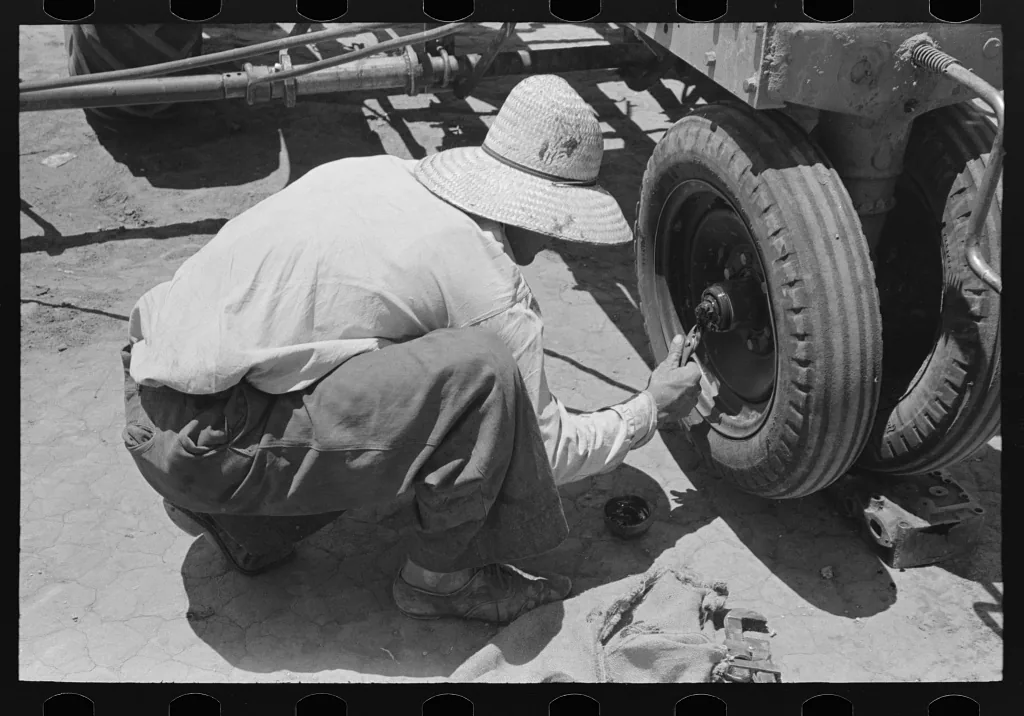
The cotter pin is almost invisible. Smaller than a finger, bent in a simple fork shape, it's the kind of part most people couldn't name if you handed them one. But on a working tractor in the middle of a 4,900-acre farm outside Ralls, Texas, that little piece of metal was the difference between a day's work and a breakdown in a cotton field — and somebody had to put it in.
That somebody was a day laborer. May 1939. The photographer was Russell Lee, one of the Farm Security Administration's most prolific documentarians, capturing the texture of American agricultural life at the tail end of the Great Depression. The negative still exists, a 35mm nitrate strip, preserved in the Library of Congress.
Most people scroll past images like this one.
Ralls, Texas, and the Scale of the South Plains
Ralls sits in Crosby County, about thirty miles east of Lubbock, right in the heart of what was — and still is — serious cotton country. If you've driven through that stretch of the South Plains in late summer, you know what it looks like: flat in every direction, the horizon so far away it almost doesn't seem real, fields laid out in near-perfect geometry against red-brown soil. In May, the South Plains are anything but still. This is the crunch of the spring planting window, when the wind comes howling off the Llano Estacado, whipping dry red-brown dust across the flats. The man in this photograph was working in that rising heat. Crouched down in the dirt, hands coated in grease and grit, he was locking down that castle nut before the tractor headed back out to drag a four-row planter across miles of open loam.
The 4,900-acre operation referenced in the Library of Congress record was enormous by any measure. For context: the average American farm in 1940, according to the U.S. Census of Agriculture, was around 174 acres. Nearly 4,900 acres put this place in a category shared by a very small number of operations in the entire country — large-scale, mechanized, and deeply dependent on hired labor to function.
That's the world this photograph comes from.
What Day Labor Actually Meant in 1930s Texas
Day laborers in the cotton economy of the South Plains were not employees in any modern sense. They were hired by the day — sometimes by the hour — with no guarantee of tomorrow's work, no benefits, no housing security. During planting and harvest seasons alike, camps and motor courts around towns like Ralls, Crosby, and Floydada filled up with families, many of them internal migrants displaced by the Dust Bowl or by mechanization itself pushing them off smaller farms elsewhere in Texas and Oklahoma.
May was one of the most demanding stretches of the entire agricultural calendar — cotton seed had to go into the ground on a tight weather window, and every tractor on the place needed to be running from sunup to sundown to make it happen. Russell Lee's other frames from this same farm that week show the same urgency: day laborers pumping up flat tractor tires, changing plow points, working across a lineup of nine tractors. This wasn't slow-season maintenance. It was triage in the middle of the busiest weeks of the year.
The man in this photograph knew what he was doing. That's not a romantic projection — it's just visible in the act. Putting a cotter pin into a tractor requires knowing where it goes, why it's there, and what happens to the mechanism it secures if it's installed wrong or left out entirely. Cotter pins hold castle nuts in place, keeping wheel bearings, tie rod ends, and other critical connections from working loose under vibration. On a machine doing heavy fieldwork in sandy loam soil during the planting rush, that matters. A broken axle or a thrown front wheel in May could cost an operator an entire day of planting during a window that didn't wait for anybody.
His knowledge wasn't accidental. It came from years of working around machinery, learning by doing, probably without ever seeing a service manual.
The Tractors That Changed the South Plains
By 1939, tractor adoption on large Texas farms was accelerating fast. Manufacturers like John Deere, International Harvester, and Allis-Chalmers had been pushing into the agricultural market hard through the 1930s, and federal loan programs — including those tied to the Agricultural Adjustment Act of 1933 — helped larger operations finance equipment purchases even during lean years.
The irony, and it's a bitter one, is that mechanization simultaneously made large-scale farming more productive and made day laborers more precarious. Every tractor that replaced a mule team also displaced the men who drove those teams. The men who remained — like the one in this photograph — survived in the economy by adapting, becoming useful in new ways, learning the mechanical language of the machines that had partly replaced them.
That tension is sitting right there in this image, if you know to look for it.
The FSA and Why These Photographs Exist
The Farm Security Administration's photography program, formally launched under Roy Stryker in 1935, produced one of the most significant documentary archives in American history. Photographers including Dorothea Lange, Gordon Parks, Russell Lee, and Arthur Rothstein fanned out across the country to document rural poverty, agricultural labor, and the human cost of economic collapse and environmental disaster.
The images they captured weren't neutral. The FSA had a specific mandate: build public support for New Deal agricultural relief programs by showing Americans what rural poverty actually looked like. The photographs were designed to create empathy, then policy momentum.
Whether that framing diminishes or adds to their historical value is a question historians still argue about. What's not debatable is that these photographs preserved faces and moments that would otherwise be entirely gone. The man fixing the tractor outside Ralls — we don't know his name. While the archive leaves the worker unnamed, Russell Lee's lens confirms he existed, he worked, and he possessed an indispensable mechanical vocabulary that kept the entire 4,900-acre enterprise from grinding to a halt.
That's not nothing.
What's Still There
Ralls is a small town today — 1,665 residents as of the 2020 census — but Crosby County is still farming country. Cotton is still grown there. The soil is still that same red-brown color. The fields still stretch to that improbable horizon.
The 4,900-acre farm in the photograph almost certainly doesn't exist as a single unit anymore — agricultural land consolidation and sale patterns have reshaped land ownership across the South Plains many times over since 1939. But the physical landscape hasn't changed all that much. And somewhere in Crosby County, there are probably a few old-timers who could still tell you, without hesitation, exactly what a cotter pin is for.
Do you have family history tied to agricultural labor in the South Plains — or a connection to Crosby County or Ralls? We'd love to hear what you know about the farms, families, and working people who built that part of Texas.

No comments yet