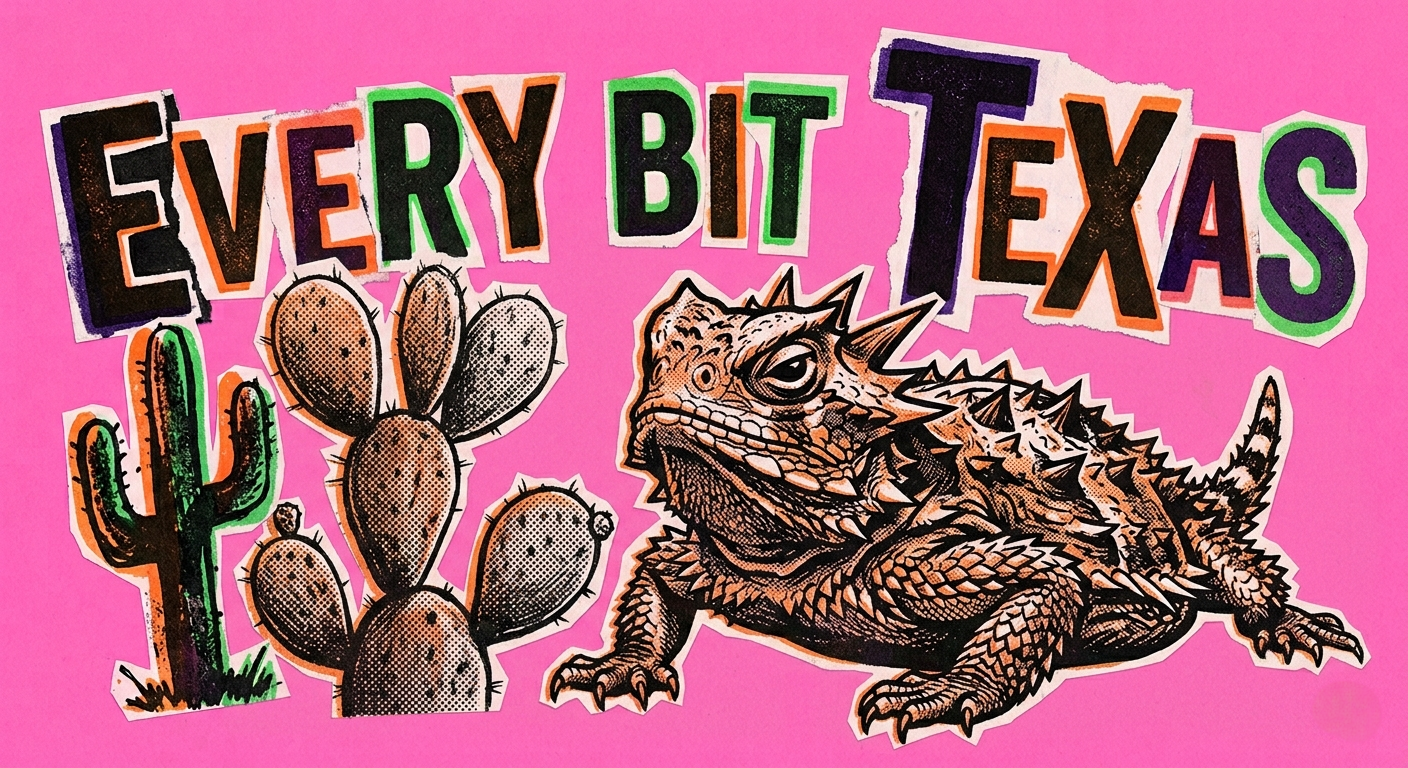
If you've noticed the Texas horned lizard popping up in your search results this week, you're not imagining it. The state's beloved "horny toad" is having a moment, and it comes down to one word conservationists have been chasing for years: reproduction.
The Discovery Behind the Headlines
Back in May 2026, researchers with the San Antonio Zoo's Center for Conservation & Research found something unexpected on a restored ranch property in Blanco County. During a routine check, a team member spotted a small horned lizard sitting just inches away in the grass. Nothing unusual about that on its own. What made this one different was its belly.
Every lizard the zoo releases gets photographed and genetically swabbed first, and each one carries a unique pattern of dark spots on its underside, almost like a fingerprint. When staff checked this lizard's pattern against their records, it didn't match anything they'd released. That raised a real possibility: this could be the first wild-born offspring of the zoo's reintroduced population, a lizard that hatched in the wild rather than in captivity.
Genetic testing is still underway to confirm it. If it checks out, it would mark the first solid evidence that horned lizards released back into Texas grasslands aren't just surviving out there. They're starting families.
The find itself happened in May, but it stayed largely within conservation circles until this week, when wider outlets picked up the story and it started spreading. That's the search spike you're seeing now: a two-month-old discovery finally getting the attention it deserves, timed right alongside a Fourth of July news cycle full of Texas pride stories.
Why That Matters So Much
The Texas horned lizard has been in trouble for decades. It's currently listed as a threatened species in Texas, and its population has fallen out of roughly 30 percent of the range it used to cover across the state. Ask anyone who grew up here before the 1980s and there's a good chance they'll tell you the same thing: horny toads used to be everywhere. Backyards, vacant lots, the edge of the driveway. Then they mostly weren't.
A few things drove the decline. Habitat loss from urban sprawl took away the loose, sandy soil and open grassland the lizards need to burrow and hunt. Pesticide use wiped out the native harvester ants that make up most of their diet. And red imported fire ants, an invasive species that spread aggressively across Texas, turned out to be especially bad news, preying on lizard eggs and crowding out the native ants the lizards actually rely on for food.
Zoos in San Antonio, Fort Worth, and Dallas have spent years trying to reverse that trend through captive breeding programs, raising lizards from eggs and releasing juveniles onto ranches and wildlife management areas where the habitat has been restored. Since the effort at Mason Mountain Wildlife Management Area began, more than 3,000 juvenile lizards have been released there alone.
What's been missing until now is proof that any of it is actually working long-term. Releasing lizards is one thing. Watching them survive, grow up, and reproduce entirely on their own is the real test, and it's the piece that's been the hardest to confirm.
What's Different About the Blanco County Site
The property where this lizard turned up isn't a wildlife refuge or a research station. It's a private ranch, and the reason it's become a candidate breeding ground comes down to the landowners' decision to rip out non-native grasses and replant native Texas vegetation instead.
That distinction matters more than it might sound. Horned lizards are picky. Unlike a lot of species that can adapt to living near humans, horned lizards need very specific conditions: bare ground for basking, loose soil for digging in, and healthy populations of native harvester ants for food. Turf grass and invasive plants choke out exactly the kind of open, scrubby habitat these lizards depend on.
If this particular lizard is confirmed as wild-born, it becomes a working example that private landowners can recreate. Restore the native habitat, and the lizards may do the rest.
The Bigger Comeback Story
This isn't happening in isolation. Conservation groups across the state have been chipping away at the horned lizard's decline from a few different directions at once. Programs at zoos in Fort Worth, Dallas, and Caldwell have released hatchlings into protected sites for years. Researchers track survival using tiny radio transmitters and lightweight tags that fall off naturally over time, letting them study how released lizards move, feed, and hold up against predators without doing any lasting harm.
Even outside Texas, the interest has spread. In Oklahoma, where a smaller and less genetically diverse population survives at Tinker Air Force Base, a local brewery has started donating a percentage of sales from its horned lizard-themed beer toward the same kind of head-start conservation work.
None of it has fully reversed the decline yet. But taken together, it's the most encouraging stretch this species has had in a long time, and the Blanco County discovery is the clearest sign yet that the work might be paying off.
A Texas Icon Worth Rooting For
There's a reason this story is resonating beyond the conservation world. The horned lizard isn't just another reptile. It's the official state reptile of Texas, a childhood memory for generations of Texans, and one of the strangest-looking animals in North America, capable of shooting blood from ducts near its eyes when a predator gets too close.
For a lot of people, the appeal isn't complicated. This is an animal that used to be part of daily life across the state and then quietly disappeared from most of it. The possibility that it's finding its footing again, on its own terms, in the wild, is the kind of comeback story that's easy to get behind.
Confirmation on the Blanco County lizard is still pending, and it'll likely take genetic testing to know for certain. But for now, it's given a threatened Texas icon its best headline in years.


No comments yet