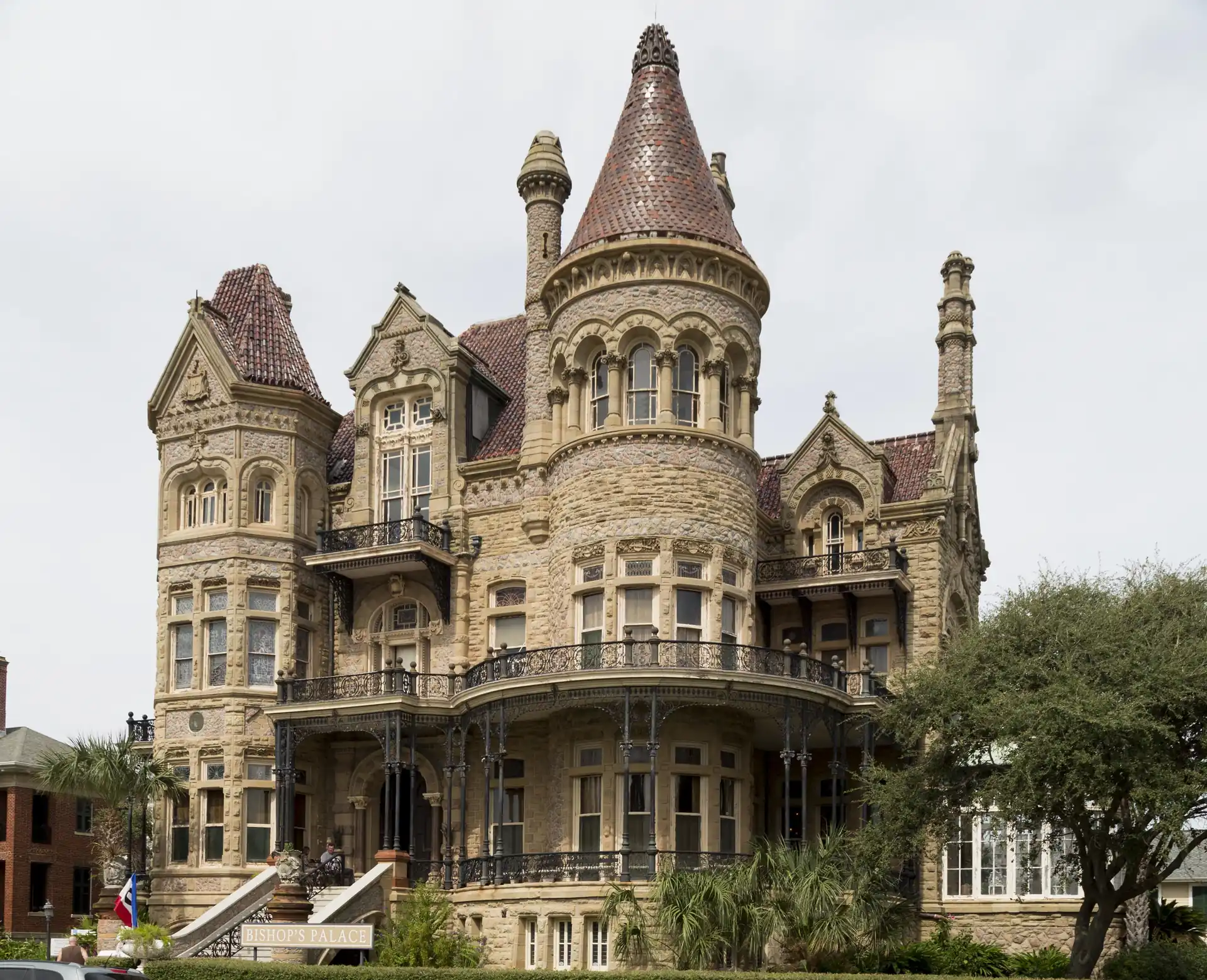
The first thing you notice is that it doesn't look like it belongs. Not to this street, not to this century, not to the flat coastal terrain around it. Standing at the corner of Broadway and 14th Street, Bishop's Palace rises out of the Gulf Coast humidity like something conjured — turrets of pink granite and gray limestone, stained glass catching the afternoon light, iron work so elaborate it looks more like lacework than metalwork. Most people stop walking when they see it. You can't help it.
Formally known as the Gresham House — locals have called it "Gresham's Castle" since before most of us were born — this is one of the most architecturally significant Victorian structures in the entire United States. The American Institute of Architects has recognized it as one of the 100 outstanding buildings in the country. That's not local pride talking. That's the profession that builds things saying: this one is different.
Walter Gresham Built a Statement, Not Just a House
Colonel Walter Gresham commissioned the house in the 1880s, and the architect he hired was Nicholas Clayton — the same man responsible for much of Galveston's most ambitious late-19th-century architecture. Clayton designed it in an era when Galveston was genuinely one of the wealthiest cities in Texas, possibly in the South. Cotton money. Port money. The kind of money that makes men want towers.
Construction ran from approximately 1887 to 1893. The materials alone tell you something about the ambition: pink granite from Central Texas quarries, gray sandstone, and hand-carved details throughout. Inside, the fireplaces are the stuff of legend — each one different, each one crafted from a distinct variety of stone or metal. There are five of them, if memory serves from the last walk-through, and no two look remotely alike.
Gresham was a lawyer and a congressman, a man who moved in circles where a home was a declaration. This one declared loudly.
The Name Everyone Actually Uses
Here's something worth knowing: the "Bishop's Palace" name came later. After Gresham died, the Diocese of Galveston purchased the property in 1923, and it became the residence of the local Catholic bishop — hence the name that stuck. The Catholic Diocese used it as a bishop's residence for decades before it eventually transitioned to its current role as a historic house museum.
So when older Galvestonians call it Gresham's Castle and younger tourists call it Bishop's Palace, they're both right, just talking about different chapters of the same building's life.
What the 1900 Storm Didn't Take
You can't write about any Galveston landmark without confronting September 8, 1900. The Great Galveston Hurricane — the deadliest natural disaster in American history, with an estimated death toll between 6,000 and 12,000 people — tore through this island and erased entire neighborhoods in a single night. The storm surge reached depths of 15 feet in some parts of the city.
Bishop's Palace survived.
The building's construction — massive masonry walls, deep foundations, serious structural weight — is widely credited with its survival. During the storm, the house reportedly served as a refuge for people seeking higher ground and sturdier walls. The irony isn't lost on anyone: a monument to Gilded Age excess became a shelter for people who'd just lost everything.
That history layers itself onto every visit. You stand in those ornate rooms and think about the water outside, the wind, the people crowded onto those floors in the dark.
Walking the East End Historic District
The house sits within Galveston's East End Historic District, which gives you some sense of context when you visit. This part of Broadway — sometimes called the "Broadway of the millionaires" in the late 19th century — was lined with the homes of the Island's merchant class. Many of those homes are gone. The ones that remain, Bishop's Palace chief among them, anchor a district that's been on the National Register of Historic Places since 1975.
If you've ever walked the stretch of Broadway from about 11th to 19th Street on a cool morning, before the tourist traffic picks up, you get a ghost-city feeling. The scale of what Galveston once was — and what the 1900 storm permanently interrupted — is written into the spacing between those surviving homes.
Bishop's Palace is open for tours, and it's worth every minute of it. The docents there tend to know their material cold, and the upper floors give you a view of Broadway that photographers have been chasing since at least the 1890s. A Library of Congress photograph from 2012 shows it in full color, the limestone and granite still standing firm against the island light — a building that has now outlasted the century that built it by more than a hundred years.
Nicholas Clayton didn't get nearly enough credit in his own lifetime. That's another story, and a sad one. But this building is his argument.
If you've toured Bishop's Palace or have a family memory tied to this building — maybe a grandparent who remembered it before it opened to the public, or a story about the East End district — share it in the comments. The history that lives in people's heads is just as worth preserving as anything on the National Register.


No comments yet