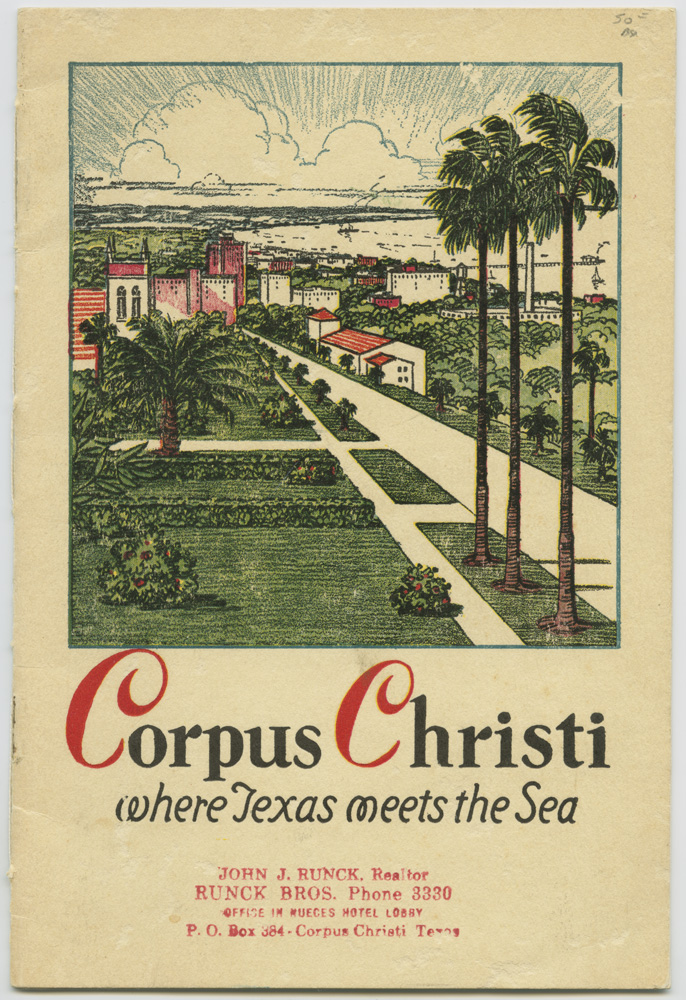
The cover illustration doesn't show you refineries. It doesn't show tankers on the ship channel, or the roughnecks driving in from fields outside of town. What it shows you is palm trees flanking a sun-drenched boulevard, a pink building rising on the left, and Corpus Christi Bay glittering in the distance — a scene so aggressively pleasant it reads more like Florida than South Texas. At the bottom, in crisp red type: "Corpus Christi, where Texas meets the Sea."
This is a 1935 pitch. And it's a very good one.
The pamphlet — produced by the Corpus Christi Chamber of Commerce and now held in the DeGolyer Library at Southern Methodist University — was available in the lobby of the Nueces Hotel, compliments of John J. Runck, Realtor, Runck Bros., phone 3330. That detail matters. Built in 1912–1913 on the waterfront between Water and Chaparral streets, the Nueces Hotel was for years the largest building in Texas south of San Antonio: 205 rooms, a banquet hall, two private dining rooms, a sun parlor, and an address planted directly at the edge of Corpus Christi Bay. The Texas Historical Commission marker placed there records it as "a center of civic and social activities" for more than 50 years. If you were new to Corpus, the Nueces Hotel lobby was where the city introduced itself.
"Where Texas Meets the Sea"
The slogan wasn't invented for this pamphlet. According to historian Alan Lessoff's Where Texas Meets the Sea: Corpus Christi and Its History (University of Texas Press, 2015), the Chamber of Commerce coined it when the Port of Corpus Christi officially opened in 1926 — and it recurred across decades of promotional materials. Nine years later, it was still the city's calling card, still being printed for hotel lobbies and handed to anyone thinking about putting down roots.
The port was the reason for the slogan. After the devastation of the 1919 hurricane, civic leader Roy Miller — who had served as mayor from 1913 to 1919, elected at 29 — spent years lobbying in Austin and Washington for a deepwater harbor. A statewide celebration marked the port's official opening in 1926; the first commodity shipped was cotton from the Aransas Compress Company. Cotton ran things for a decade. Then the oil came.
What the Illustration Actually Shows
The view on the pamphlet cover is the Broadway Bluff — the 40-foot rise that separates downtown from uptown Corpus Christi, several blocks back from the waterfront. Mayor Miller had commissioned New York civil engineer Alexander Potter to redesign it in 1913, under the City Beautiful movement then popular nationwide. Voters approved bond funding the following year; construction ran through 1918: concrete retaining walls highlighted with elegant balustrades and grand stairways, landscaped terracing descending toward the bay. The Texas Historical Commission designated it a Recorded Texas Historic Landmark in 1986.
In 1935, that view opened directly onto Water Street and the water beyond — because the seawall hadn't been built yet. The bond for seawall construction wouldn't pass until 1938. Shoreline Boulevard, today's iconic waterfront drive, didn't open until March 1941. In the pamphlet year, the bay was right there at the foot of the bluff, undivided by any landfill or road. The Corpus Christi the illustration showed was more open to the water than anything visitors find there today.
Corpus Christi in 1935: The Hinge Year
The Great Depression was still grinding. Corpus Christi was largely insulated from the worst of it, for one reason: oil. Crude had been discovered in Nueces County in 1930, and the years that followed moved fast. The city's population had climbed from 10,522 in 1920 to 27,741 in 1930 — and would nearly double again to 57,301 by 1940. Eight refineries were operating along the ship channel by 1937. By 1936, petroleum had surpassed cotton as the Port's dominant export.
The Chamber of Commerce was selling palm trees, sea breezes, and beach access to Padre and Mustang islands — and all of it was real. But the oil was realer, and it was writing the city's actual future. Del Mar College opened this same year, 1935. The Naval Air Station was still six years out. The seawall was three years away. Everything was in motion.
A realtor working out of the Nueces Hotel lobby that year understood perfectly which way the city was blowing.
The Pamphlet Survives
This 16-page document — described in the DeGolyer catalog as covering the city's history, natural resources, and climate — is what Corpus Christi wanted you to think of it in 1935. The palm trees on the cover were real. The bay was real. "Where Texas meets the sea" was sincere. But behind the illustration, on the ship channel, the refinery stacks were already going up.
What do you know about Corpus Christi's early history — before the seawall, before Shoreline Boulevard, before the Navy base changed everything south of downtown?
Sources: DeGolyer Library, Southern Methodist University — Corpus Christi, Where Texas Meets the Sea, 1935. Texas Historical Commission markers: Nueces Hotel site (1983), Broadway Bluff Improvement (1986). Alan Lessoff, Where Texas Meets the Sea: Corpus Christi and Its History, University of Texas Press, 2015. Texas State Historical Association Handbook of Texas: "Corpus Christi, TX."


No comments yet