What did Dallas look like when the whole country was at war — and one Texas city was quietly becoming the Southwest's most ambitious skyline? 🏙️
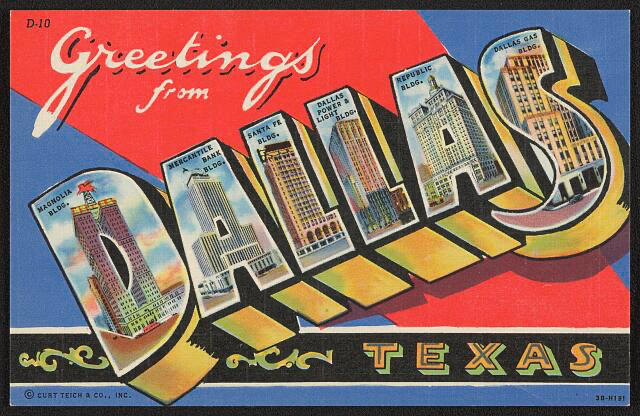
This 1944 linen postcard from Dallas Post Card Co., printed by the legendary Curt Teich & Co. of Chicago, captures the answer in a single image. Each letter of D-A-L-L-A-S is filled with one of the city's defining buildings, giving us a snapshot of downtown at the height of World War II — a city already drunk on oil money and building its way into the future.
The Buildings in the Letters
D — Magnolia Building. The crowned jewel of the skyline. Built in 1922 as headquarters for the Magnolia Petroleum Company (later Mobil Oil), it was Texas's first true skyscraper and the tallest building west of the Mississippi when it opened. You can see the famous Pegasus on top — the 40-foot rotating red neon flying horse installed in 1934 to celebrate the American Petroleum Institute's convention in Dallas. At the time, that winged horse glowed above everything. It's still up there today, atop what is now the Magnolia Hotel.
A — Mercantile Bank Building. The newest building on this postcard when it was printed. The 31-story Mercantile National Bank Building, designed by Walter W. Ahlschlager (architect of New York's Roxy Theater), was completed in 1943 — the only major skyscraper finished during the entire war. It briefly became the tallest building west of the Mississippi, edging out the Magnolia, and housed both private banking floors and federal war agency offices.
L — Santa Fe Building. Built in 1924 as the main office building of the Gulf, Colorado and Santa Fe Railway complex, this Mission Revival beauty at 1114 Commerce Street was one of the most desirable addresses in Dallas for two decades. Four buildings were linked by a subterranean freight tunnel; today Santa Fe Building No. 1 houses federal government offices.
L — Dallas Power & Light Building. Completed in 1931 at 1506 Commerce Street and designed in the Art Deco style, this was the home of the utility that kept Dallas's lights on through the Depression and war years.
A — Republic Building. Republic National Bank was already one of Dallas's major financial institutions by the mid-1940s and occupied a prominent downtown building. The bank's flagship tower — later one of the most striking postwar skyscrapers in the South — wouldn't open until 1954.
S — Dallas Gas Building. The original 1924 headquarters for the Dallas Gas Company, which grew into Lone Star Gas and eventually into today's Atmos Energy. The Art Deco complex that grew around it still occupies a full block downtown, though it's been empty since 2005.
Curt Teich and the Linen Postcard Era
The postcard itself is a product of the golden age of American souvenir cards. Curt Teich & Co. of Chicago dominated the market with their “linen” postcards — named for their textured, cloth-like paper stock — and produced millions of large-letter cards just like this one for cities across the country. The bold colors, boosterish pride, and careful selection of civic landmarks made them time capsules of American urban ambition. This one was published by Dallas Post Card Co. and numbered D-10 (3B-H191), placing it precisely in the Teich archive.
In 1944, as soldiers shipped out from Love Field and oil money flowed through Commerce Street, this little card was somebody's way of saying: look at what our city has become. 🤠
About This Image
This postcard is held by the Library of Congress with no known restrictions on publication. Published by Dallas Post Card Co., printed by Curt Teich & Co., Inc., 1944.
<!-- ebt-meta:{"cities": ["dallas"]} -->


No comments yet