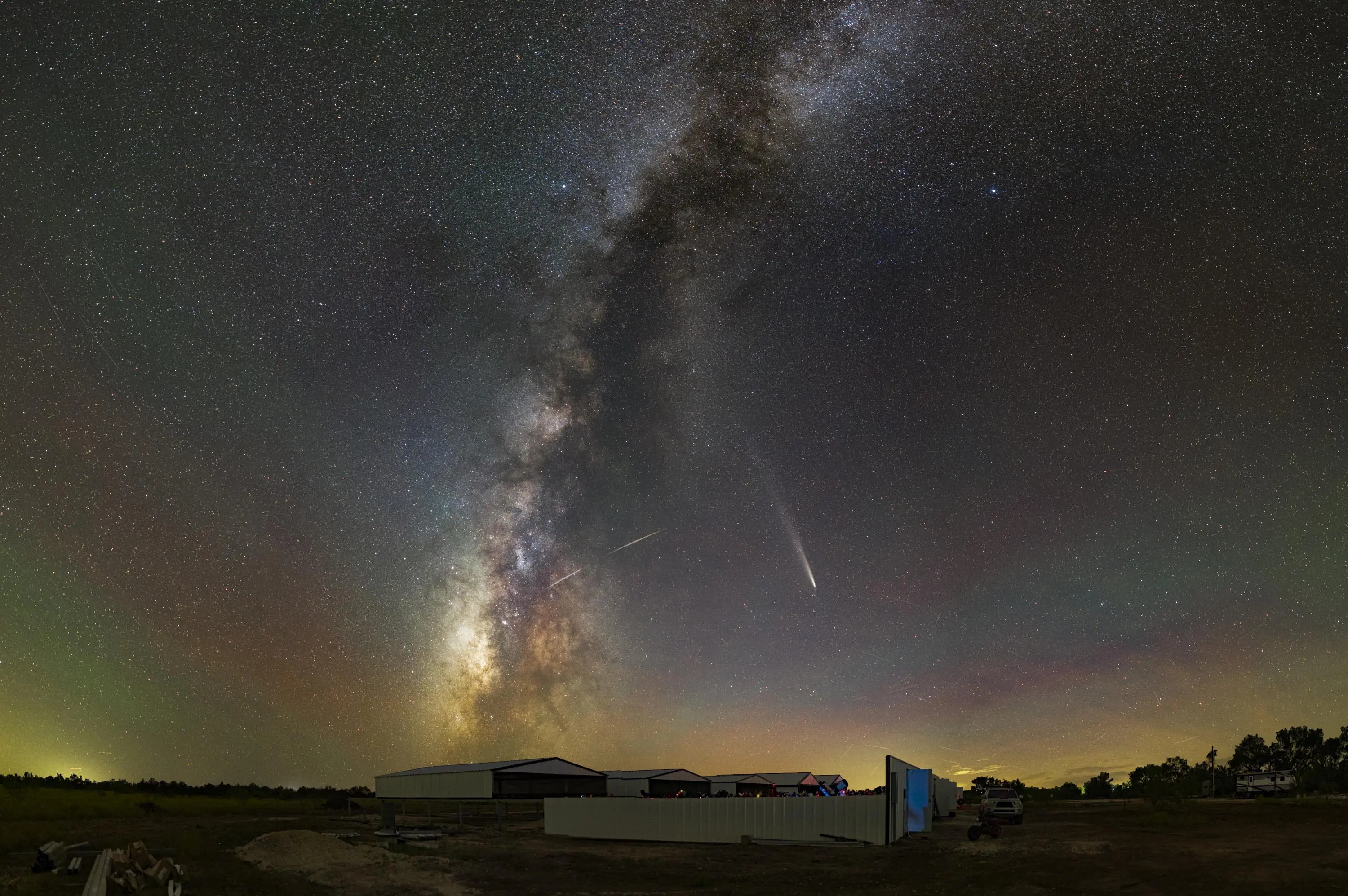
Drive twenty-five miles north of Brady on Highway 283 and you will pass through Rockwood, Texas, an unincorporated community in southern Coleman County with a population you could fit in a single church pew. There is no stoplight. There is a post office. And on a patch of ground that was cattle pasture until the spring of 2024, there are now more telescopes than most countries own.
That is Starfront Observatories , and it has quietly become one of the strangest, most ambitious businesses operating under Texas skies. Customers ship their telescopes to this stretch of Coleman County, where a small crew installs and maintains the equipment so the owners can log in from anywhere on Earth and point their scope at a nebula thousands of light-years away. The buildup got national attention in October 2025, when the New York Times sent a reporter and photographer to Rockwood and described the site's eleven roll-off-roof sheds as a "robot army awakening" each night as the roofs slide back in unison.
How a Cattle Field Became an Astrophotography Capital
Starfront was founded in 2024 by four people who met through a space-industry startup called Oursky: Bray Falls, Josh Kim, Dustin Gibson, and Nathan Hanks. Falls had been doing astrophotography since he was a young teenager in his parents' backyard in Phoenix, and the founders saw a gap in the market. Remote observatories already existed in places like Utah, New Mexico, and Chile, but they mostly served wealthy individuals or institutions with high-end gear and deep pockets, according to the Times's reporting. Starfront's founders wanted to make the same dark-sky access available at scale, to people who would never otherwise get it.
Scaling that idea required a location with two things that rarely show up together in rural Texas: genuinely dark skies and serious internet infrastructure. Rockwood had both. The skies overhead register as Bortle Class 1, the darkest rating on the nine-level Bortle scale used by astronomers worldwide, and the area had access to fiber. That second part mattered more than it might sound. Every clear night, the observatory's telescopes generate a flood of image data that has to move off-site, and a rural town without fiber would have choked on it.
We reached out to Starfront to ask the team to walk us through the origin story directly. Here is what they told us, in their own words.
The Interview: Straight From Starfront
What's the origin story of Starfront? How did the idea come about, and what made Rockwood the right spot?
"The idea for Starfront came up when we all realized that there was a large portion of the astronomy community that was underserved in terms of their ability to access dark skies," the team explained. "Remote observatories have existed before, but largely for institutions or wealthy individuals who could afford it. So we decided to offer the same access to dark skies but to a wider market at scale. That scale required a place that had both great conditions for astronomy, and infrastructure for hosting a large number of telescopes. Rockwood in particular had excellent access to fiber internet, which was critical for this idea to work due to the large amount of image data moved out from the site every night."
Walk us through how it actually works for a customer. They book a session, then what happens?
"There are two different customer flows at Starfront, one for those without a scope and one for those bringing their own," they said. "For a customer without a scope, we offer Seestar telescope rentals which give you direct access to a telescope at the observatory for a flat monthly rate. You sign up, we give you the logins and instructions to access and operate the scope, and then you can be capturing images of space within minutes once the roofs are open. For people with a telescope, you have to either ship or drop your scope off at the facility to get it here. From there we install the telescope according to your instructions, and once the telescope is ready to use you are able to log in and use it to capture photos."
What kind of objects can people observe? Are there certain nights or seasons that are especially special out there?
"People can observe anything and everything in space — galaxies, nebulae, star clusters, comets, quasars, supernova remnants, etc.," the team said. "Every season at the observatory offers something different. Depending on the position of Earth in its orbit, the nighttime side of our planet points towards different directions. In the summer, we can get a clear view looking inwards on our galaxy towards the Milky Way core; this time of year there are numerous different nebulae to see. In the spring, the night sky looks outwards from our galaxy, and most of the objects visible are distant galaxies instead of nebulae. In the winter and fall, the Orion arm and winter Milky Way are visible, and this part contains some of the best nebulae in the sky."
Who's your typical customer? Astronomy enthusiasts, families, first-timers?
"The typical customer here is an amateur astrophotographer, perhaps with their own backyard setup they have been using for some time from light-polluted skies," they said. "We also get a large amount of first-timers trying out our smart telescopes for the first time."
What's been the most memorable or surprising moment since you opened?
"My most memorable astronomy moment since opening has probably been the time we got to see the Aurora Borealis during a particularly strong solar flare in 2024," the team said. "It was something I never expected to see in Texas!"
That wasn't a stray memory. In May 2024, a geomagnetic storm classified G5, the strongest such event since 2003, pushed the Northern Lights as far south as Florida and the Texas coast, according to NASA's Earth Observatory. For an observatory built around chasing dark skies, watching the aurora ripple over Coleman County was the kind of night nobody on staff is likely to forget.
What's next for Starfront? Any big plans on the horizon?
"The next things for Starfront are to continue to expand and push on making smart telescopes accessible to more people than ever before, and to potentially expand into the southern hemisphere to open up access to the other half of the sky that isn't visible from the north," the team said.
What the Numbers Look Like From the Outside
Independent coverage backs up the scale Starfront describes. The New York Times reported in October 2025 that the facility, built on land the founders bought in April 2024, had grown to more than 550 telescopes spread across eleven roll-off-roof buildings, calling it by far the largest such facility in the world by the company's own account. Pricing starts as low as $99 a month for a shared Seestar smart telescope and runs up to roughly $399 a month for the largest dedicated pier reservations, depending on the size and weight of the equipment being hosted, according to Starfront's own FAQ page .
Starfront says its Rockwood site averages more than 220 clear nights a year and that customers regularly record sky quality readings of 21 to 22 magnitudes per square arcsecond, a figure on the dark end of what's measurable in the continental United States. The mechanics behind keeping all those telescopes dry and online are almost entirely automated. An automated control system monitors weather and sky conditions, and the roofs on each building roll back shortly before sunset and seal again after sunrise. A staff of on-site technicians handles installation and basic troubleshooting, while a Discord server keeps customers connected to each other for tips, troubleshooting, and a recurring favorite: the Collective Telescope, a monthly project where dozens of users point their individual scopes at the same target simultaneously to gather enough combined light to pull out detail no single instrument could manage alone.
A Long Way From a Backyard in Phoenix
Co-founder Bray Falls has built a public following around the project that extends well beyond Coleman County, and the company itself documents the build-out of the facility and the night-by-night realities of running it on its YouTube channel and its Instagram and X accounts. It is a long way from a kid pointing a telescope into a Phoenix backyard, but the through-line is the same one the team described to us: getting more people to actually look up.
Anyone interested in seeing it firsthand, virtually at least, can find Starfront's setup documented across those channels and inside the company's Discord , with customer image galleries showing what Bortle 1 skies over Coleman County actually look like once the roofs roll back.
Have You Tried Remote Astrophotography?
Texas has dark-sky pockets all over the western half of the state, but turning a rural plot into the largest telescope hosting operation in the world is a different animal entirely. Have you ever shipped gear to a remote observatory, or are you tempted to try a smart telescope rental for the first time? Tell us in the comments.



No comments yet