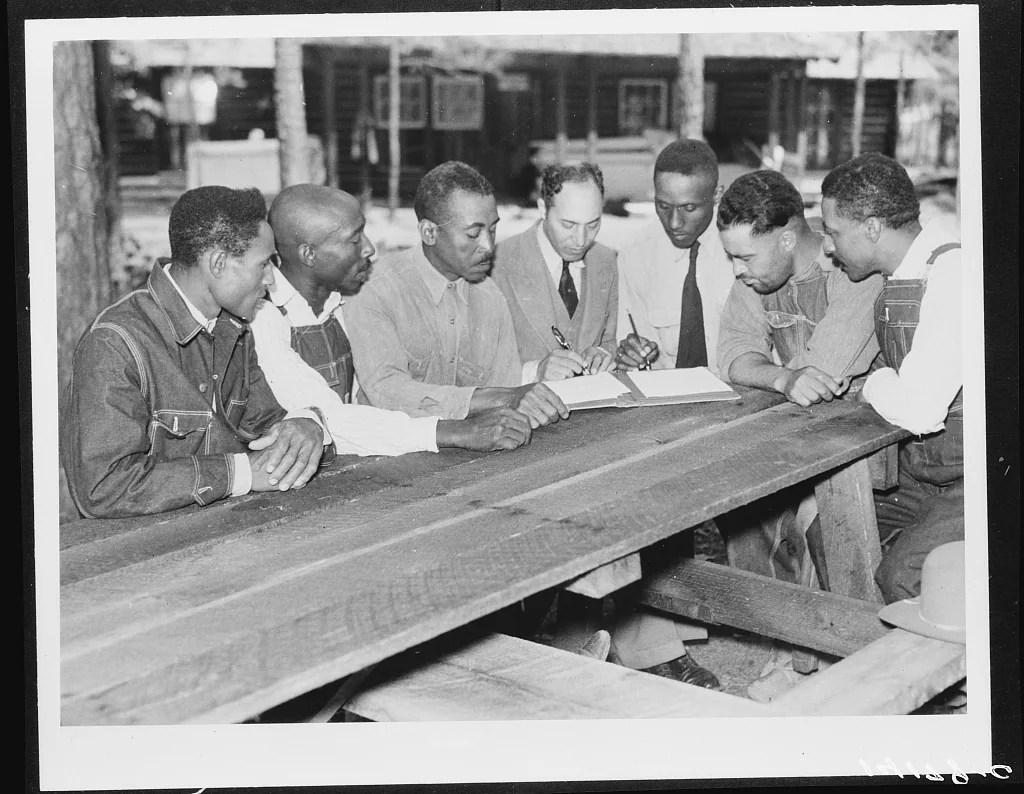
A room full of Black farmers. A physician. A contract.
That’s what the camera captured at Sabine Farms near Marshall, Texas, sometime in early 1941 — and the photograph, now preserved in the Library of Congress nitrate negative collection, is quietly one of the more remarkable images of community self-determination to come out of Depression-era East Texas.
The scene documented here is simple on its face: homesteaders at Sabine Farms signing a contract with Dr. A.O. Lee, a Black physician based in Marshall, to provide medical care for the community. But sit with that for a moment. These were families who had been systematically excluded from most mainstream healthcare infrastructure. And they didn’t wait for the system to fix itself. They built their own arrangement.
What Sabine Farms Actually Was
Sabine Farms wasn’t a plantation and it wasn’t a sharecropping operation — which is exactly the point. It was a New Deal resettlement project, part of a broader federal effort during the 1930s and early 1940s to relocate impoverished rural families onto government-purchased land where they could farm independently and build lasting equity. The Farm Security Administration, which oversaw projects like this across the South, specifically created several resettlement communities for Black farm families who had almost no other path to land ownership in the Jim Crow era.
The Sabine Farms project sat in Harrison County — not Jefferson County, despite what some catalog metadata suggests — near Marshall, the county seat. Marshall was already home to a significant Black professional class, including educators connected to Wiley College (founded in 1873 and famously the home of Melvin Tolson’s debate team), and physicians like Dr. Lee who served a community that white medical institutions largely refused to treat.
The homesteaders at Sabine Farms weren’t tenants. They were buyers, working toward ownership through government-backed loans and structured agricultural programs. That distinction mattered enormously. It shaped what kind of community investments they were willing to make — including negotiating a group medical contract.
The Contract Itself
Prepaid group medical arrangements like this one weren’t common anywhere in 1941, but they were particularly rare in rural East Texas. The concept — a community pooling resources to guarantee a physician’s services on an ongoing basis — predates what we’d now call health insurance cooperatives, but it’s exactly that in spirit.
Dr. A.O. Lee appears in the photograph as the physician party to this agreement, though the historical record on him beyond this image is thin. What the photograph confirms is that he was a Black physician practicing in Marshall, willing to enter into a formal contractual relationship with a rural homestead community. That combination — a credentialed Black doctor, a landowning Black farming community, a written legal agreement — represented exactly the kind of institution-building that made white supremacist power structures in the Jim Crow South deeply uncomfortable. Documented, contractual, professional. Hard to dismiss.
The FSA, to its credit, actively encouraged these kinds of community arrangements at its resettlement projects. Photographs like this one were part of the agency’s documentation mission — showing not just hardship, but evidence of competence and civic organization. The FSA photography program, which employed Dorothea Lange, Gordon Parks, and Russell Lee among others, produced tens of thousands of images. Most people know the iconic poverty portraits. The photographs of Black community professionals and organized rural institutions get far less attention.
Nobody talks about this part enough.
Marshall’s Place in All of This
If you’ve spent any time in Marshall, you know it’s a town with layers. The courthouse square, the old Ginocchio Hotel building, the Amtrak station that still runs the Texas Eagle through — it’s a place that holds its history close. And for Black East Texans in the first half of the twentieth century, Marshall occupied a particular position: it had Wiley College, it had a Black business district along Grand Avenue, and it had Black medical professionals like Dr. Lee who could actually serve the community.
Harrison County in 1941 was still deeply segregated. The county’s Black population — which had been majority Black through much of the late nineteenth century — had been systematically disenfranchised and economically marginalized for decades by then. Sabine Farms represented a genuine crack in that structure. Federal dollars, going to Black families, to buy land, with organized community services attached.
The photograph doesn’t tell us how long the contract with Dr. Lee lasted, or what the terms were — dollar amounts, visit frequency, scope of services. That information, if it was ever recorded, would live in FSA administrative files rather than the photographic record. It’s genuinely unclear whether those records survive. What we have is the moment of signing, which is something.
A Different Kind of New Deal Story
The New Deal’s relationship with Black Americans is complicated and contested among historians. Many New Deal programs actively excluded Black workers and families, either by statute or by administrative practice at the local level. Agricultural programs in particular often ran through county committees dominated by white landowners who had every incentive to keep Black farmers poor and dependent.
Resettlement projects like Sabine Farms were different — imperfect, paternalistic in their own ways, but genuinely aimed at building Black land ownership rather than undercutting it. The FSA’s documentation of that work, including photographs like this one, was part of an argument being made to Congress and to the public: that these families were capable, organized, and worthy of investment.
The image of farmers signing a medical contract with their own physician makes that argument without a single word of caption.
What the Nitrate Negative Tells Us
The original negative is nitrate film, 4x5 inches or smaller — standard press and documentary photography format for the period. Nitrate negatives are notoriously unstable, prone to deterioration and, under the wrong storage conditions, genuinely flammable. The fact that this one made it into the Library of Congress collection and has been digitized is not a small thing. A lot of images from this era didn’t survive.
The photograph itself is a document of a transaction. People seated or gathered, pen in hand or documents on a table — the visual grammar of a contract signing, which is its own kind of statement. These families knew they were being photographed. They knew the image was going somewhere. They signed anyway, deliberately, on the record.
Eighty-some years later, it’s still on the record.
Do you have family connections to Sabine Farms, to Dr. A.O. Lee, or to Black healthcare history in Harrison County? If your people were part of the Marshall-area community during the New Deal era, we’d genuinely love to hear what was passed down — share what you know in the comments.



No comments yet