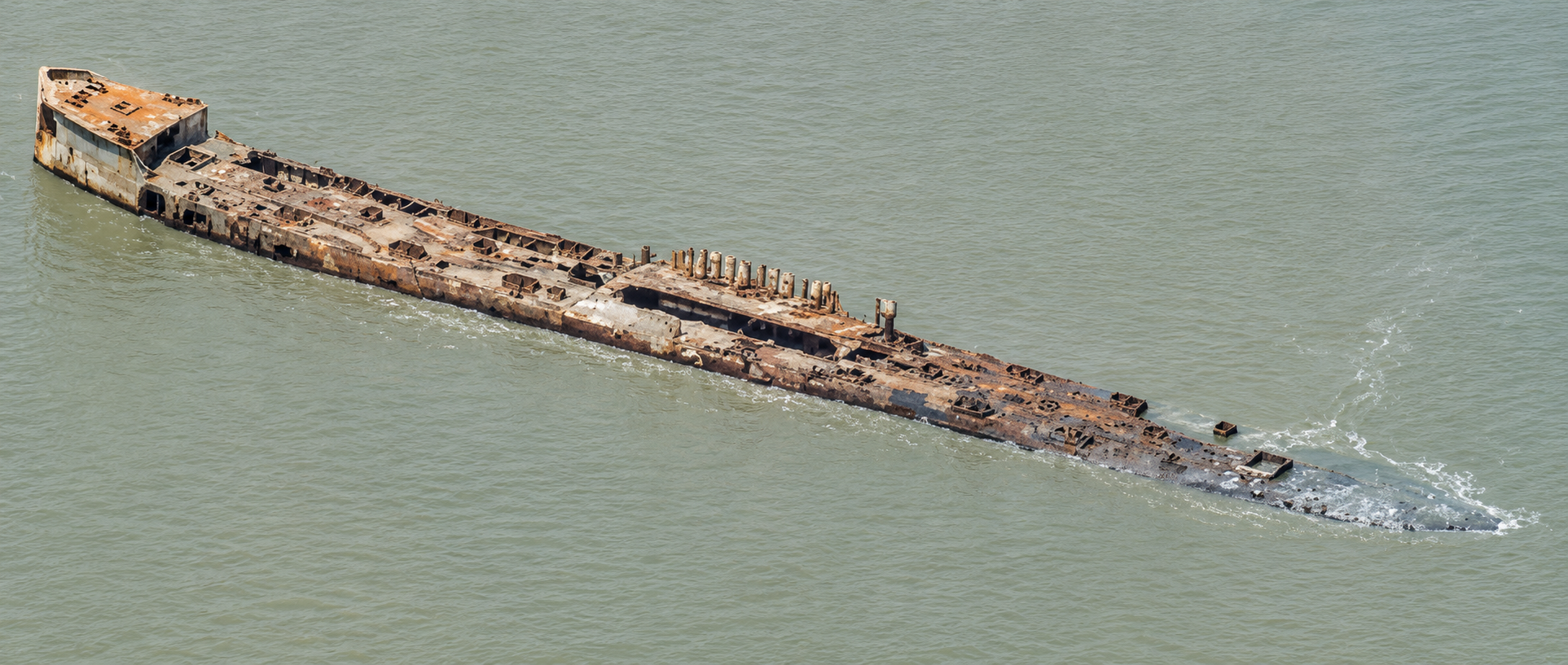
You can see it from the Bolivar ferry. Most people don't know what it is — just a gray, barnacle-crusted silhouette jutting from the water off Pelican Island, neither quite sunk nor afloat. That's the SS Selma. She's been in Galveston Bay since 1922. She was a warship that arrived on the last day of the war. She was an oil tanker that barely lasted a year on the job. She was a bootlegger's cache, a chicken farm, and briefly a national media sensation. She's now a wildlife habitat and a designated National Historic Place. All of this happened to a 431-foot ship made of concrete.
The Selma was built to fight a war that ended before she launched.
The SS Selma: Built for a War That Was Already Over
When the U.S. entered WWI in 1917, steel was being diverted to weapons and warships, leaving shipyards short of material for cargo hulls. President Woodrow Wilson approved an experimental program to build merchant ships out of reinforced concrete. Of the 24 vessels ordered, only 12 were completed. The Selma was the largest of those — built by F.F. Ley and Company in Mobile, Alabama, at a final cost of $1,865,950.16. Named to honor Selma, Alabama, for its wartime liberty bond drive, her hull was only about four inches thick, relying on expanded shale aggregate and internal rebar for structural strength.
She launched on June 28, 1919. That same morning, Germany signed the Treaty of Versailles.
The Selma entered service as an oil tanker in the Gulf of Mexico, which was not what anyone had planned but was what the moment required. Less than a year in, on May 22, 1920, she hit a jetty at Tampico, Mexico, tearing a 60-foot crack in her hull. She was towed to Galveston for repairs — and there the problem became clear. No shipyard had the knowledge or tooling to patch a concrete hull. She sat at the docks. In July 1921, another steamer, the Carmarthenshire, struck her at the pier and opened a second hole. After that, her owners gave up on both repairs and sale attempts.
On March 9, 1922, crews dug a 1,500-foot channel off Pelican Island's eastern shoreline and scuttled the Selma into it. She's been there ever since.
Prohibition, Explosives, and a Possible Spy
A concrete hull sitting in the middle of Galveston Bay turned out to have its uses. In 1926, the Selma briefly served as dynamite storage. That same year, federal agents began using the wreck's hold for a different purpose: on September 29, 1926, over 11,000 bottles of confiscated bootleg liquor — worth an estimated $91,000 on the street — were transported by barge from Pier 22 to the Selma and smashed in her hold. Galveston's position on the Gulf made it a major entry point for smuggled liquor; the Selma was used for liquor destruction on at least four occasions during Prohibition. In 1928, an oil exploration company used the hulk as a work staging area.
In March 1942, two men boarded the supposedly deserted Selma to use its radio equipment and found a stranger inside, eating what was described as a lavish breakfast. He refused to explain himself or his presence. German submarines had been spotted in the Gulf that winter; the two men suspected an enemy spy relaying ship movement reports. The stranger was never identified.
One Hundred Dollars, Ten Easy Payments
On May 3, 1946, Clesmey Noleska LeBlanc — Frenchy to everyone who knew him — paid $100 for the SS Selma. In ten easy payments.
Frenchy was a Galveston fisherman and handyman, 70 years old when he moved into the bow of the partially submerged wreck and set up what one period account called "very light housekeeping." He raised chickens and goats on the exposed deck. Friends ferried him ashore periodically so he could sell goat cheese and eggs to island residents. He tried raising oysters in the flooded hold. That experiment failed. He kept fishing off the deck instead.
The Galveston Daily News later wrote that Frenchy "never bothered with taxes or rent and fed his chickens while the tides rolled beneath him."
In 1947, a Galveston promoter named Christie Mitchell — known on the island as "The Beachcomber" — organized a "Happy Hermits Convention" aboard the Selma, with Frenchy as host and emcee. Mitchell advertised free beer. Forty to fifty self-described hermits arrived by rowboat: drinking, singing, pushing each other off the deck into the bay. Fox Movietone and Universal News filmed the whole event, and the footage ran as short-subject newsreels in movie theaters coast-to-coast. Frenchy, the concrete-ship hermit of Galveston, was briefly a national curiosity. Mitchell observed: "Frenchy changed his shirt as often as he changed his tattoos."
He kept living there long after the cameras left. In the early 1950s, his health declining, Frenchy finally moved ashore. He died December 23, 1956, at the age of 80, and is buried at Calvary Catholic Cemetery in Galveston.
What the SS Selma Is Now
In 1992, A. Pat Daniels — retired editor of both the Galveston Daily News and the Houston Chronicle — purchased the Selma and made her preservation his mission. Through his efforts, the ship was designated a State Archeological Landmark in 1993, placed on the National Register of Historic Places in January 1994, and given a Texas Historical Commission marker in 1995. She also carries the designation of Official Flagship of the Texas Army National Guard.
Core samples pulled in the 1950s found the concrete below the waterline had actually increased in strength by 57 percent since 1919. The steel rebar inside showed almost no corrosion. After more than a century in salt water, the hull is structurally tougher than the day it was poured.
Brown pelicans roost on the exposed rebar. Sheepshead and speckled trout work the hull's shadow. The Galveston Historical Foundation's Seagull II harbor tour passes close enough to the wreck to see the crumbling deck and the steel ribs poking through the concrete. From the Bolivar ferry, she's on your left as you leave the island — a shape that doesn't look like anything else in the bay.
Have you ever fished the Selma wreck, spotted her from the ferry, or run across a piece of this story you hadn't heard before?
Sources: Texas Historical Commission marker, SS Selma, Galveston County (1995). Find a Grave memorial #162386818 (Clesmey Noleska LeBlanc). Galveston Monthly, "The SS Selma." Houston History Magazine, Vol. 11, No. 2 (Spring 2014). Galveston Daily News, July 1962. Encyclopedia of Alabama, "S.S. Selma." National Register of Historic Places NRHP #93001449 (January 5, 1994).


1 Comment