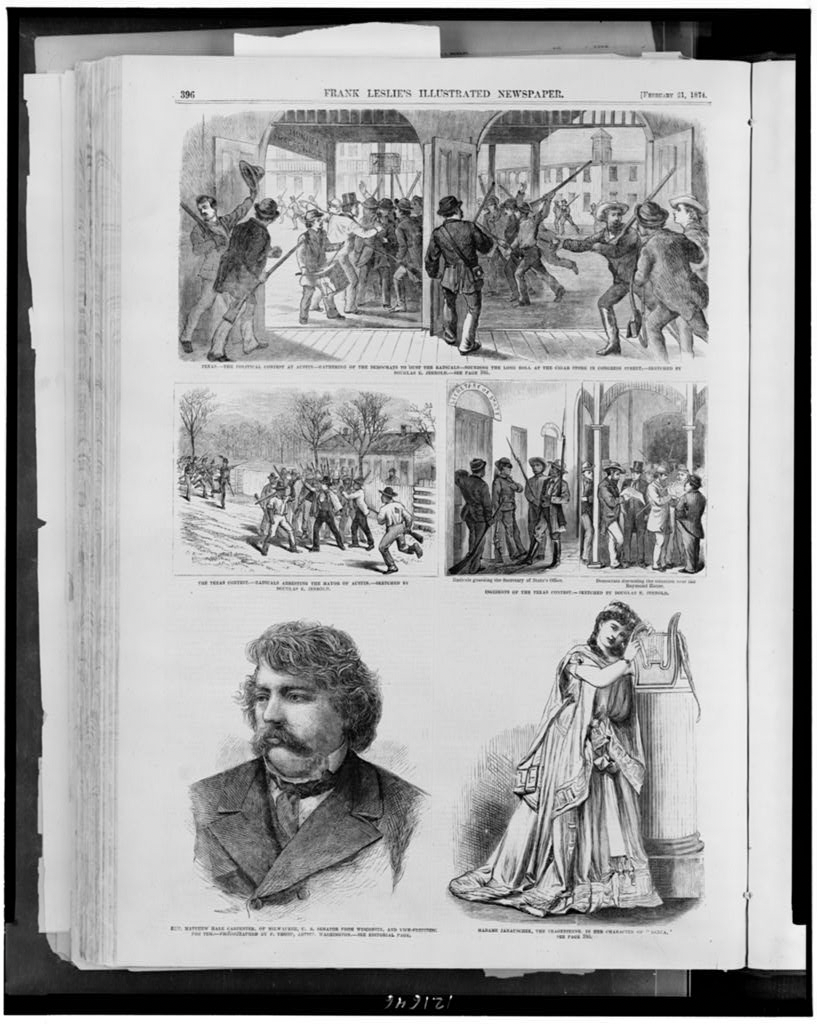
Did you know the end of Reconstruction in Texas came down to a standoff inside the State Capitol — and a disputed semicolon? 🤠
In January 1874, Austin was a city on a knife’s edge. Democrats from across Texas had descended on the capital with one mission: remove Radical Republican Governor Edmund J. Davis from office after he lost the 1873 gubernatorial election by a margin of nearly two to one. Davis, however, had no intention of going quietly.
The Election Davis Refused to Accept
On December 2, 1873, Democrat Richard Coke crushed the incumbent Davis at the polls, pulling in roughly 66 percent of the vote. But Davis wasn’t done. He leaned on the Texas Supreme Court — a bench he had appointed — which voided the election in a ruling known as Ex parte Rodriguez. The court’s reasoning? The election was unconstitutional because polls were only open for a single day instead of four, as required by the Constitution of 1869. The entire case hinged on how a semicolon in the constitutional text should be interpreted. Texas historians have called it the “Semicolon Court” ever since.
Nobody accepted the ruling. The newly elected Democratic legislature simply ignored it, organized in the second floor of the old Capitol building, and confirmed Coke as governor. Davis and his Radical Republican allies barricaded themselves on the ground floor below. For a tense stretch of days, Texas had two governments operating in the same building. 🏗️
Armed Democrats, a Locked Door, and an Axe
It wasn’t just a political argument playing out in committee rooms. Democrats physically moved to secure key offices around Austin — guarding the secretary of state’s office and, in a move that would make any Texan raise an eyebrow, arresting the mayor of Austin himself. Davis called in state troops to his defense, but when those troops arrived, they sided with Coke. He also appealed to President Ulysses S. Grant for federal intervention, but Grant telegraphed back a refusal, reportedly indicating that the election results should stand.
With no federal backup and the legislature above him certifying a new governor, Davis finally surrendered on January 19, 1874. In a last act of defiance, he locked the door to the governor’s office and took the key. His successor’s supporters broke the door down with an axe. Richard Coke walked in and Reconstruction in Texas was over.
About This Illustration
This wood engraving — “Incidents of the Texas Contest” — was sketched by Douglas E. Jerrold and published in 1874. It depicts four scenes from the crisis: Democrats gathering to confront the Radicals, the arrest of Austin’s mayor, armed guards at the secretary of state’s office, and Democratic leaders conferring on next steps. The illustration also includes a portrait of Matthew Hale Carpenter, the prominent Radical Republican U.S. Senator from Wisconsin who was a staunch ally of President Grant and one of the leading constitutional defenders of Reconstruction-era policies across the South. The piece is held by the Library of Congress Prints and Photographs Division with no known restrictions on publication.
#TexasHistory #TexasReconstruction #AustinTexas #TexasPolitics #TexasCapitol #ReconstructionEra #TexasHeritage #EveryBitTexas #LoneStarHistory #TexasThen #CivilWarEra #TexasLandmarks

No comments yet